
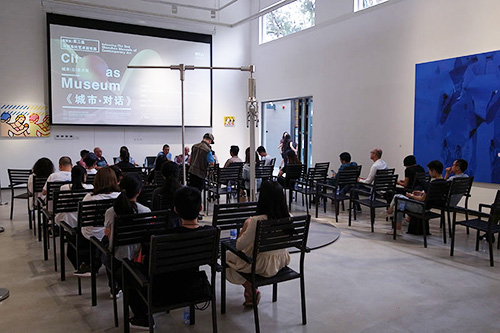
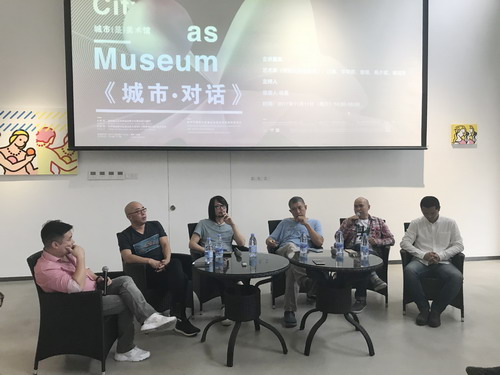
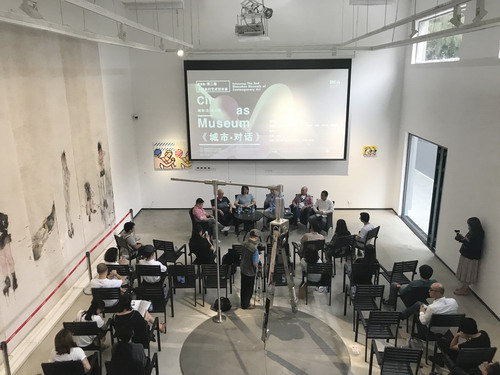
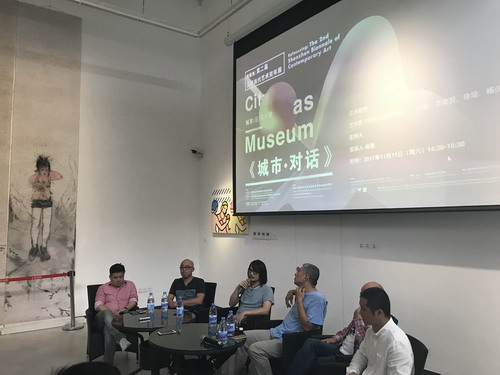
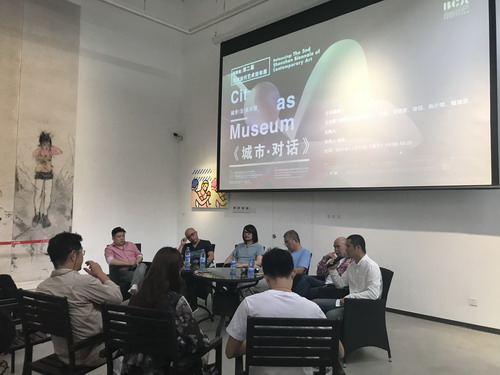
Yang Yong: Today we’re having our third activity of this year’s “City (as) Museum” edition of Shenzhen Biennale of Contemporary Art. With “City • Dialogue” as the title today, we would like to hear the various opinions and views of every one of you, artist or not. Apart from our five invited artists – Yang Shaobin, Jiang Heng, Xu Tan, Yu Xudong and Li Rongwei, we’re very happy to have some other artists here, such as Mr. Zhang Meng, a multi-media artist from Tianjin Acadmey of Fine Arts; Mr. Hu Chijun from Guangzhou Academy of Fine Arts; Ms. Su Zhiting from the Department of Fashion Design, Shenzhen University; and Ms. Xue Yang, one of the keynote artist speakers at the second academic activity of this show. With so many excellent artists sitting among the audience and, on stage, our five keynote artist speakers, I think this dialogue will turn out to be an open discussion. I’ll bring up a few points for our discussion today to revolve around. “City (as) Museum” is the theme of this second Shenzhen Biennale of Contemporary Art. When we were giving guidance to visitors, making relevant explanations and taking interviews, we mentioned the core idea of the theme every time, which, perhaps, is that we’re trying to systemically liberate museums and add something constructive to them with a hypothesis in a very potent way, or whether we should do some thinking or self-reflection to respond to the booming of conventional musuems and the high-speed evolvement of the industry in Shenzhen or China, so we’re repeating this museum topic with an active and discreet self-reflective mentality. For a long period of time in the past, Shenzhen was universally recognized as a “cultural desert”, but the rapid development and the increasing investment in economy, IT, design and high technology have started to make Shenzhen City an expected platform for the art market. In a short period of time, a great many museums were set up in Shenzhen, along with the holding of a good many exhibitions, some expositions included. Personally, I take this phenomenon as the result of a kind of “over expectation”. I think we can first invite our five artists on stage to shed some light on the topics. To begin with, they will share with us their interpretations of the exhibition theme and their understanding of and advice on this biennale in Shenzhen. Li Rongwei, for example. He’s been living in Shenzhen for many years, and is still a very young artist. And Mr. Xu Tan have also spent a long time living and working in the city. The other artists, too, are no strangers to Shenzhen, and they all have their different understandings as to the current cultural atmosphere and art of this city. Now I’ll let them have the stage, and later I’ll invite some other artist friends I just introduced to share their points of view, and then we can have some interactions and conversations. Let’s begin with Mr. Xu Tan.
Xu Tan: As I’m based in Guangzhou, I’d never been to Shenzhen until the middle 1990s when I met Ou Ning in Shanghai and he asked me to take a look at the activity he was doing at the time. Then in the late 1990s, in 1997, I came to know Yang Yong, and back then, there was no such thing as an art circle in Shenzhen. So every time when I came to Shenzhen, I went straight to Yang Yong’s, as he was the only one practicing avant-garde art at the time. Right, “avant-garde art”, and the term later gave way to “contemporary art” around 2000. We could still find young artists emerging in the early 2000s, but in the middle, between 2005 and 2006, many of these artists moved to Beijing. But Yang Yong still live and work in both cities, Shenzhen and Beijing, alternately. So that’s why it was called “cultural desert”, the term Yang just brought up. It seems that, at the beginning, the term “cultural desert” actually referred to the whole PRD region. Then started in 1992, Guangzhou had an exhibition that attracted a lot of artists from all over China, the title “Guangzhou • The First 1990s’ Biennial Art Fair”, and the curator was Lü Peng. At that time, a lot of very “weird” people appeared around CAFA, long-haired or long-bearded, so the teachers of CAFA would banter, “They are making us look much less like artists. We’re too normal.” Today all teachers in CAFA have long hair and beard. The artists from North China, like Wang Guangyi, surely had the qualifications to say “Guangzhou is a cultural desert”, they had good reasons to see Shenzhen and Hong Kong as cultural deserts. But that really upset the art group “Big Tail Elephant” at the time, so they made up their mind to change the situation. After years practicing art, “Big Tail Elephant” managed to kill the belief that “Guangzhou is a cultural desert”, but, instead, people now are just saying “Guangzhou is not artistic enough”. Many artists have left Guangzhou for Beijing, because they failed to earn a living as an artist in this environment. But now I find it very interesting that the title “City (as) Museum” has received a great deal of attention. Yesterday, the host of San Francisco Chinese Art Center contacted me to praise our good adoption of this theme, he said, it’s a different matter from whether or not the place is a desert of culture and art, but clearly a new concept has found its way out, that is to say, art is no longer the concept we used to imagine; instead of throwing shows in a museum, we’re now promoting the concept of art, in a way of what we now call “social practice”, to integrate art into our social life, so here’s a new fundamental question for art: Is art all about the works being hung in a museum, only for the limited population who are interested in the field? So in this exhibition we can see a big number of young artists’ pieces, which I find rather interesting. They are no longer the products of our previous concept like whether a painting is well painted or not, but about the work’s connection to our survival and to our everyday life. For example, what does a painting have to do with me when I’m at home? Or for someone who has sold or given the painting to someone else, how does the transfer affect the connection? This, I think, is different from our old way of looking at problems after ruling out the urban and social environment, so this direction is worth much indepth research in the future and there’s a lot of work to do.
Jiang Heng: Mr. Xu Tan has just given us an analysis of the situations in the PRD region, featuring Guangzhou and Shenzhen. I’m from Hubei province, and had my first show in Shenzhen in 2001, in He Xiangning Art Museum, the title being “Youth in Transition”, with participating artists from four countries. The curator was Mr. Huang Zhuan, artist Zhang Xiaotao was responsible for inviting foregin artists and I domestic ones. So we were coopearting in a rather small team, but we managed to have the exhibtion in place. Then in 2003, I participated in the “Image inside Image” show in Shenzhen Art Museum. Before that, in fact, I had also participated in a few other shows in Shenzhen. But I have different impressions of Shenzhen and Guangzhou. For example, I find that, in Guangzhou, it’s a rather solidified cultural deposit and environment and there may be a certain standard; but, in Shenzhen, it’s a very dynamic cultural environment, and, as it’s a city of immigrants from every part of China, people care about culture in a unique way. I think that Shenzhen’s cultural landscape today has resulted from a variety of factors. It’s not like Guangzhou, which is rather stable in tradition. We all know there’s a Lingnan School of Painting in Guangzhou; it’s rooted in the city and has made itself part of the city’s history. So usually people also linger on this understanding of art in their everyday life. Fortunately, in the early 1990s, a group of Hubei teachers decided to leave home for this land in South China, which also showed me the threshold of contemporary art. I’ve been profoundly influenced by them. Contemporary art was still a very broad concept at the time, so, as an art maker, I didn’t take it too seriously, because I believe that an artist’s creation is mostly an individual thing and has a lot to do with his living environment and the culture he pays attention to. Later I came to realize that, since artists including my peer teachers have been studying this field, it has already, no matter how, shown itself on the Chinese and even international stages. Back to the topic, I think this “City (as) Museum” show curated by Yang Yong reminds me of Marcel Duchamp’s idea of putting a urinal in the museum. It may be performance, and it may also be sensible and conceptual, so I have come up with some similarities between the two. For example, we are living in a world where stories happen at every corner and each is different, like stories that happen in a bustling city or an unfinished building. For those who are wandering around in the city, the mood varies from person to person, so such a kind of social spectacles constitute a cultural landscape of the society. Thanks to this very age of advanced communications where the whole world is making progress together, museums have also changed greatly. For example, we have museums that are state-owned or private, and we also have other art organizations; especially in the last few years, a great number of private organizations and museums have been founded. In South China, Shenzhen is the most typical and extremely dynamic. Some say that this is a “cultural desert”, but I take it as a place where a new form of culture has come into being; there are a world of possibilities in it, so this particular geographic and cultural environment in Shenzhen naturally gave birth to Yang Yong’s conception of “City (as) Museum”. It just occurred to me that, in an article co-authored by Gaston Bachelard and Avner de-Shalit, The Spirit of Cities, there’s such a concept: in the age of globalization, cities give us the ability to move them. The proposal of this concept has a lot to do with the framework and history of cities, and with the cities’ cultural and social situations at present. So as an artist, when discussing such a topic, we tend to relate it to some of our personal experiences. The development of our society and of the whole world today has also been bringing something new to individual artists.
Yang Yong: We have here, among the five, Li Rongwei, an artist who works with an art institution, and perhaps the youngest artist on the stage. He’s also been working with our OCT Contemporary Art Terminal (OCAT) and OCT Art & Design Gallery – a museum group under OCT. While practicing his own art, he also takes part in the construction of cultural and art exhibitions. Perhaps he can share with us his parallel state of personal art-making and working in the museum.
Li Rongwei: I’m actually a newcomer as an artist. But I have been working with OCAT Shenzhen since I graduated in 2006, so I’m at a rather older artistic age in the institution. There are several parts of my job. One is my work in the institution. I know Mr. Xu Tan and Mr. Yu Xudong are also quite familiar with OCAT as they both have participated in some OCAT exhibitions. In 2007, OCAT was still under He Xiangning Art Museum, so I’m quite familiar with both He Xiangning Art Museum and OCT Art & Design Gallery. When I first arrived in Shenzhen in 2006, I also came with the impression that Shenzhen was a “cultural desert”, as at that time there were actually quite a small number of artists living and working here. To my knowledge, the pioneers include the Niuhu artists who back then were based mainly at F518 Idea Land, and the artists in Wutong Mountain who were previously based at Honggang Garden, and Mr. Yang Yong was one of them, but later many went for the opportunities in Beijing. Perhaps for an institution, every time we decide to do an exhibition, we have to invite basically all productive artist resources from out of Shenzhen. I can only recall one show we did purely about local Shenzhen artists. Over so many years, especially since 2014, great changes have really happened to the entire environment of the city; we have more and more art museums and art institutions. New galleries are coming into Shenzhen continually in recent years. The credit actually goes to the entire cultural policy and the dynamic environment because of the economic development in Shenzhen. It certainly also has to do with the cultural pursuit of young people in this new age, like every weekend, there are a quite a number of visitors coming for the shows in OCT-LOFT. Different cultural demands give birth to institutions like us that are devoted to this kind of production. In fact, the government has been a great help with the cultural development promotion funds.The idea “City (as) Museum” tries to break citizens of the habit of going to museums for exhibitions and to make all public areas of the whole city into places for the emergence and growth of art. So this idea actually has a lot in common with the Western concept of public art, as it changes the property of space, allows art to happen to any place and helps a city gradually develop and accumulate its cultural atmosphere. Maybe in a few years, nobody will dare to allege Shenzhen as a “cultural desert”, but come to realize that this is really a new city model, it’s very dynamic and that its efficiency and sustainability are the envy of the world.
Yang Yong: The next one will be Yu Xudong. Yu Xudong is a very experienced artist. He started making contemporary art and doing related activities very early in Guangzhou, and he’s still very active and quite productive today. Maybe he can share with us his way of working in Guangzhou, in the PRD region.
Yu Xudong: The first time I came to Shenzhen was in 1994, perhaps. I hadn’t been to college yet and was studying painting in Guangzhou. As I was out of money, my friends invited me to paint in Dafen village in Shenzhen. They even brought me to the red-light district of the city. It was a street at the time, with many colorful, impressive billboards. I felt like being in a food market. Then for years, I didn’t get to know much about the city. I just traveled a lot via Shenzhen to Hong Kong for exhibitions after I graduated. After 2007, apart from some shows in OCAT and Boxes Art Space, I am still not familiar with Shenzhen, in fact. But I’m looking forward to UABB in December, as it’s an event with shows around the city. I think it just agrees with “City (as) Museum” on the point of being everywhere. Our studio has a “Xi-San Film Studio” project this year in some other village, which will be part of UABB, and Mr. Xu Tan is also in on the project. One of the main purpose of this project is to create a new connection. And the theme “City (as) Museum” gives me the idea that what we should think about in such a place as Shenzhen is where the connection is for everyone in our field. It’s a very lively and active place in Shenzhen these years, with so many exhibitions and activities, so I would interpret this theme as a generator of a new connection.
Yang Yong: And we also have artist Mr. Yang Shaobin, who’s spent a long time in North China and is now based in Beijing and America. Mr. Yang has lived through a very large part of China’s contemporary art history and made many achievements. It’s actually very lucky to know he’s still doing a lot of thinking on his new work today, and also some questioning about some of his previous works. He is no doubt an embodiment of robust creativity, so I’d like to invite Mr. Yang Shaobin to share with us his experience of doing contemporary art in North China and, after that, we can talk about the understanding of and the thinking on these cities in South China.
Yang Shaobin: It was in 1991 when I went to Yuanmingyuan in Beijing from Tangshan, Hebei. Back then, the Yuanmingyuan area was not called artists village, and only a small group of artists were based there, so it was a very lonely place. I dove into painting as soon as I got there in 1991. That was a very tough time. I couldn’t even afford a small courtyard of any farmer, so I found a place where I could share the rent with two or three others. We painted together, lived together, and often even starved together. In the winter, we didn’t have coal to keep warm, so I asked my fellow townsmen for some and some cabbages. That’s how we lived those days. Later, in 1993, there came many writers and journalists in Yuanmingyuan, and, even, a German TV station also reported on the place, so things got a bit different from then on. In fact, after 1989, the government didn’t want to see these independent artists gather in one spot, and, besides, the works of the painters around Yuanmingyuan were somewhat political indeed, so things got bad again in 1994; there were often stories of artists being taken away and stuffed back to where they came from. So in 1993 and 1994, I shifted to another place for creation, but it was not friendly as well. The day we got there, we received a phone call from the police saying that we couldn’t stay. I believe Guangdong has never had this kind of political atmosphere, so it’s safe in this sense. But in Beijing, it was a stressful time for artists, as the police would come for a visit anytime. They saw us as “mangliu(vagrants)”, jobless so income-less. But in fact, I think that it was quite happy to do art in the 1990s since there were already artists from other countries like European who wanted to collaborate with Chinese artists, and this was a real encouragement for our seniors and young artists who just arrived in Beijing. Without the previous efforts of our seniors, it’d be really hopeless for us to hold on. My connection to Guangdong has been my participation in exhibitions held here, such as Guangzhou Tiennial; and I would also come for the shows of my northern friends here. I came to the impression that the three places, Beijing, Shanghai and Shenzhen, have the best exhibitions, of very high quality. Take Shenzhen as an example. You have OCAT Shenzhen, He Xiangning Art Museum, that is, the OCT area; I think you’ve been doing a great job, as the artists are from different cities. Later, I came to know Mr. Xu Tan when he was a member of “Big Tail Elephant”. It was quite a realistic place in Guangzhou at the time, unlike Beijing where artists were still rather idealistic. In spite of all the stress of living in Beijng, it was still a place of hope, of a good atmosphere; we had a big number of people practicing art, so we could encourage and comfort each other. Since 2000, as the market’s been getting better, there’ve been more and more opportunities for a number of artists. But I don’t know what Guangdong was like at the time. Beijing is the capital, the center of Chinese culture, so has a strong atmosphere of collecting contemporary art, and artists actually have also been very energetic working in such a environment. For my personal history in art, I’ve actually been through four or five stages. From the earliest “Cynical Realism” to “very violent” expressions, then the interest in international politics, followed by the exhibition of a project about miners and then the one in relation to the environment. Over the years in the field of art, I’ve been trying to better my system of artistic creation so than I can work systematically in my own way. Although my style of painting is very different from before, I think this is the point I want to discuss about the philosophy of contemporary art.
Yang Yong: Alright. That’s all for our artists’ statements. Now I’d like to invite Mr. Hu Chijun from the auditorium for a few words. He’s been living in Guangzhou for a long time and persisting in art-making over the years. And he’s also taught a great number of students and witnessed the growth of CAFA artists. In Guangzhou, there are also some art organizations founded spontaneously by artists. Maybe he can share the perspective of Guangzhou with us to enrich our discussion today about the development of art in cities.
Hu Chijun: Me and Yang Yong came to know each other at Art Basel 2003. Bofore then, the contemporary art activities of “Big Tail Elephant” had quite an impact; then from the start of Guangzhou Triennial, we linked the art circles between Shenzhen and Guangzhou through the activities in Loft345 in Guangzhou. But as time went by, Guangzhou seemed trapped in “a break” on this, including the construction of museums and the development of contemporary art, while in Shenzhen the governmental support has brought the cause of culture to a new level, making a serious gap between Shenzhen and Guangzhou. Xu Tan and Yang Shaobin have already talked about the problems of living and developing in Beijing for an artist. The theme this time, “City (as) Museum” or some similar concept, I think, is actually the current situation. It reminds me of the days in the 1990s when we got deep and remote into a mountain in Guangzhou with the belief that new ideas might come to us if we did art in the wilderness or countryside; we ourselves are where art is made. For example, Zheng Guogu from Yangjiang has made some very interesting works of art in that lonely place. And I also remember clearly Xu Tan’s works about his father made in the 2000s. The concept here tells us that a city can really act as a museum, a space for art to happen in and to nurture artists’ creation, or that the city provides a lifestyle to fuel the creation of artists; it can be just a background or the source of inspiration. I think this is a very good theme. That’s all.
Yang Yong: Next I’d like to invite Ms. Su Zhiting, who’s teaching at the Fashion Design Department of Shenzhen University and actually quite an expert in art, urban culture and even architectural design. I also know that she pays much attention to pan-culture. Today we are actually talking about a very pan-culture-like topic of art. So maybe Ms. Su can share with us some of her personal views.
Su Zhiting: I’m Su Zhiting, from the College of Design, Shenzhen University. Compared to the other artists here, I’m just a laywoman in art, as my specialty is design. I was in the middle of schooling in Beijing when my family decided to move to Shenzhen in 1993. At that time, I found Shenzhen a very boring place, because in Beijing I could make a lot of friends from the cultural circles. So the early days in Shenzhen, I could find nothing but boredom here. To be honest, I even had heartfelt contempt for this city at the time, and then I went overseas. When I returned in 2006 to take the job in Shenzhen University, I started to learn about this city again. It’s been about ten years already, and I am one of the witnesses of contemporary art gradually taking form and thriving in Shenzhen. I think we have a lot to look forward to in the future. I would often tell my students that the most charming part of Shenzhen is that it’s a city of youth and hope. So there are a lot of uncertainties in it. You’re living and working in it but you cannot imagine what you or this city will be like five or ten years from now. So with such a belief, I feel my life full of energy and my mind full of infinite fantasies. This may be an incomparable part for Beijing with a very deep cultural root and Shanghai with its very regional culture. Just like Shenzhen University is outshone by Peking University and Tsinghua University in various aspects, which is an imcomparable point, but I think Shenzhen University has the charm of being young and innovative. We don’t have big masters teaching here, but we have a good many creative young teachers back from overseas with a lot of fresh ideas and passion for this city. I think these can really inspire our students when integrated into our teaching process. We all know that Shenzhen is a “City of Design” and Shenzhen University is arguably the first comprehensive university in Shenzhen. Being in the field of design, I’ve got the chance to witness that our school has provided the city with so many talented designers who, I believe, are the hope for Shenzhen’s development. As to contemporary art, from my laywoman’s point of view, I used to think that it was a lofty thing that belonged to a certain group of people, but the subtle changes in recent years have been building a larger and larger audience of it. This is actually a very good thing, because a bigger number of fans can greatly stimulate artists’ desire to make good works. Because art doesn’t serve only a small group of people and it should help improve the aesthetic education of China. The influence of contemporary art should not go to only a small group of people but a larger one or everyone. So I have expectations for this city, for contemporary art, and also for the entire art education.
Yang Yong: Just now we’ve stated our basic views on this theme. Now, as a host, I’d like to pose two questions to our artists on stage, and the others can also join in. Personally, I’m also an art maker and, together, me and my artist friends have been doing avant-garde art since the mid-1990s. When I started participating in exhibitions in Beijing in the 1990s, there was no role for the PRD region to play, and at the time over half our opportunities were to exhibit overseas. Then the art market in Beijing began developing, into a very big attraction. It’s a very magnetic atmosphere of art in Beijing. Many artists from Guangzhou also moved to Beijing at the time, including Cao Fei and Lin Yilin. In my case, I had actually not spent that much time living and working in Beijing. I just went to Beijing a lot after my solo in 2008. I’m from Sichuang but left later for Guangzhou and lived a southern life from then on until I had the itch for a life in North China, so later I also went to Beijing. Between 2004 and 2007, Beijing had a very flourishing art market, but its counterpart in the PRD region seemed impervious to Beijing’s influence as it didn’t get very well because of Beijing’s situation. Guangzhou might have benefited more from it, but Shenzhen followed neither side at the time. During my stay in Beijing, especially after the financial crisis in 2008, things got bad in the art market, starting a tough time for artists. Back then we’d often pay attention to some emerging art institutions in Beijing, like Ullens; shining though, they didn’t change the fact that it was not that good a market at the time. So since 2015, Beijing has been somewhat influenced by Shanghai, as many magnificient musuems has been rising one by one in Shanghai and done a good job, including the Expo. One of the problems in Beijing was that studios became the nightmares for many artists, who were very upset staying there for the studios’ unstableness. That’s why many artists started to leave Beijing two or three years ago. I was back in Beijing this National Day festival and every group of artists I ate out with were discussing the problem of studios, mainly about whether to move to Shanghai or not. Then I’ve learnt that many Sichuanese artists have returned to Chengdu, because they began to have expectations for the city; as there’ll be be an expo in Chengdu too next year, they are very ambitious now. And it was about that time when I came to realize that I might have more platforms to work with in Shenzhen, and these platforms are the results of some needs of this city and its people; we need more duties or more dedication and research to get the city liberated a little. So we made a copy of the Shenzhen Pavilion at the 2010 Shanghai Expo back in Shenzhen, founded Space E6 and did a lot of exhibitions, and then we began to devote ourselves to Shenzhen Biennale of Contemporary Art and UABB Shenzhen, so I’ve been putting more and more time back into Shenzhen. At the same time, we’ve also found that quite a number of artists who went to Beijing for a try years ago have now returned to the PRD region for new explorations. This is a trend, as there have been different changes in differnet cities. This afternoon I read a piece, very interesting; it first mentions the lively air in ART 021 Shanghai Contemporary Art Fair and West Bund Art Fair a few days ago and describes a phenomenon that many Chinese aritsts now are proud of painting the same as Western artists would and it’s difficult to find any Chinese observation in many artists’ expressive forms. They saw a lot of such works of Chinese artists in the fair that rounded up a world of artworks. I think that the artistic vitality of a city or the opportunities a city can offer artists and those for the public to participate more in art events are periodic, because they are always changing, never in a single aspect. Like contemporary art in Guangzhou needs the motivation or dynamic of some market and it’s definitely not the only aspect. In the case of Shenzhen, it used to be a “desert”: in the 1980s, there was only “working-class literature” in Shenzhen culture, nothing else; then in the 1990s, graphic design stood out in Shenzhen, because the printing industry in Shenzhen back then was very important for China, and those to be printed also need designing, which motivated a lot of very good graphic designers, but, of course, this chapter was turned over very quickly; from the year 2000 on, the city entered a period of rapid expansion and construction, so a lot of very good opportunities went to architects, including many foreign architects; and then we have the current stage where people have started to expect something from the spirt of the times and from art and culture in their fairly well-off life, maybe because we already have some built-in structures and planning and have also laid some foundations for being a “city of design”. For example, art fairs, which were terrible, are also getting better now. So it would sometimes come to me that every such span is part of some inevitability. If you really want to talk about contemporary art’s value to Shenzhen at that time, I dare to say there was none at all; we don’t aspire to be seen as avant-garde artists of the city who had some kind of opportunities to help shape the culture of this city. Me and Xu Tan, for instance, would often take a walk somewhere in Shenzhen and we never knew there’d be more and more friends joining us in this cause, or perhaps not too many actually have. But we have seen many phenomena of it being consumed by the government, enterprises and commerce, or of them desiring to consume art. Let’s put aside whether this is a good thing or not. I want to bring up this topic again. How do we cope with the demand of “being consumed” by today’s society in art-making? I’d like the artists here to shed some light on this. The consumption I’m bringing up doesn’t only refer to collectors collecting art, but also to this society’s or some community’s desire to consume academics or art or to their expectations from either. This is quite a free thing. I want it to be a very relaxed topic, but I don’t know if it’s any easy for you to make a point, or if I’ve made myself clear enough. It’s just that I’ve seen a lot. Like we would run into real estate businesses and they would always tell us that they are doing cultural real estate, and claim that it is not commercial but a kind of matching, but actually everything they do is to cover their commercial acts with a beautiful package. Personally, in fact, I’m not an anti-commercial kind of person, and I believe that commerce is a big help in promoting the development of something and the society. So, as an artist, what do you make of this question?
Yang Shaobin: I think that in recent ten years or less, the biggest change is that capital is becoming more and more powerful, enough to influence the market and contemporary art. In the past, we thought that it was a very great thing for a curator or critic to do a big biennale or an exhibition in a big museum, we didn’t perceive capital’s influence, but in recent years we’ve slowly realized the tremendous influence of capital.
Yang Yong: Right, so back then we didn’t see so many real estate businesses and cars of every brand all having connections with art.
Xu Tan: Agreed. Capital’s influence, as they two just mentioned, not only goes to art but also to politics. I think it’s strange that many have embraced capital actively but also have a lot of complaints about it. For example, I have a handsome young artist friend in USA who often sends me some pictures and talks about his work. The way I see it, he’s going upwards in a proper system of capital through his work, which I find understandable, but he would still complain about it from time to time, like a few days ago he sent me a photo of Yang Fudong collaborating with Rolls-Royce. I thought this is the path you’ve taken yourself but why you still crticized things like this. Then I know that there must still be something imperfect about the system. This is a rather embarrassing topic, because you know you don’t want to be fully absorbed by capital when reminded of the independence of contemporary art. It’s quite a difficult thing that you don’t want to lose your own independent spirit and criticism when you also desire to play on this great stage provided by powerful capital in such an age. A few days ago, during a meal with my friends, I also talked about why I would suddenly feel like quitting this game in 2009, so it was actually the doing of such feeling. But if you refuse to play ball with capital, the consequence will be yours to suffer, and of course you won’t starve, but there will be an increasingly huge gap between you and the society.And we’ve just heard Ms. Su from Shenzhen University talk about Shenzhen. I think she really understands Shenzhen. I’m also from outside this city, and I’ve lived here for many years, but mine is a worse case in that I’m just very slightly connected with Shenzhen’s contemporaneity, and all the few connections are basically through Yang Yong. At first, they told me that some artists were having a show in a restaurant in Shenzhen, and then I went in for a look and found that I didn’t know any of those artists. But I have also been trying to connect with the city. A few days ago, I took a night walk from Jingtian to OCT, and the feeling of walking in this city is very different from those in other cities. Take for example when I was getting near Zhuzilin on Shennan Boulevard, I found there would always be some others around and some scooters rushing by. This is impossible in Berlin or New York, or even in Beijing during the winters, so I know this is really a new city. And compared to my night walks earlier in Berlin when I came across a lot of old houses, I think the streetscape really makes Shenzhen a “garden city”, better even than Singapore. It’s being designed into the most eye-pleasing and most beautiful city in the world. Such beauty, however, seems built on a place with something missing. Hong Kong, you might find it a city with character and it might appear in your mind as some specific image, and the same goes for Beijing, Shanghai and Guangzhou, but the image of Shenzhen seems concealed. I believe that there must be one for it, apart from this beautiful cityscape, but it’s just that its image is concealed in contemporary culture. So, if you go on living in Shenzhen, what resources can you contribute to its spiritual or cultural construction? For me, I think Yang Yong’s photos taken in the 1990s can remind one quickly of Shenzhen, and no painting I’ve seen, made by those drifters about the city, can give us a strong impression that this is Shenzhen, like the show Gong Jian did looks very absurd to me as, in his imagination, Shenzhen is a hairy city. So in fact, it’s not very easy to connect art creation with Shenzhen. I believe this may not be the problem of the city, but one of this age. Because, in terms of contemporary art, political correctness is an emphasis for many contemporary artists outside of China, as well as for many domestic ones who have almost the same touch in painting. Specifically, they’re dealing with the problems of ethnic minorities, immigrants and racism, and with some consequences the early communist movements have left. But you cannot find these in Shenzhen, because it’s too perfect a city. And it’s all because of its young age, which makes it hard for you to criticize it. I think that there IS a duty for artists based here, that is to reveal the real character of the city. This is my opinion.
Yang Yong: In fact, right after I posed the question about art and commerce, I felt kind of nervous abruptly. Why? I believe I must be the one here facing this question most often among you guys, because in recent years, apart from my own artistic creation, I’ve also started an institution, and our institution always has to deal with such perplexities, as we have to face a lot of businesses, including various clients and real estate companies. As a matter of fact, we have had a lot of pleasant experiences cooperating with them, but there were of course also quite a number of very unhappy and disappointing ones. I think that maybe it’s still a short time since me and my colleagues entered this field, but at least for me it’s a very fresh experience, different from that of myself being an artist for about 20 years. I’ve also explained to my friends why I decided to go in for this, like maybe when we’ve become an institution, it will be more convenient to do some larger exhibitions or some work that requires more qualifications. And I also hope that we can present more excellent artists and works to connect with the different aspirations of the city, but I think such connections depend on our way of seeing it. Like we have to stay professional, and we must dare to argue when a business takes us as an advertising agency; we must insist that these are works of art and must be respected, and that this exhibition I’ve managed to put on is worth mentioning to my friends in the world of contemporary art, but not just something I have to hide from them. These are my true words. Currently we actually have to face a lot of such struggles at work. I want to keep as much of our original intentions as we can, or try to build a link between our clients and art or academics so that they can be more understandable, but, in fact, art is really nothing but a rigid requirement in their eyes. They spare a little part of their budget to hire artists or to invite artists to participate in activities; they surely have some business objectives in this. So I’ve come to be more aware than some artists that, before we decide to take a job, we should first stand in their shoes to do some thinking, to figure out what they really need, and then we assess whether there’s in this any space for fulfilling some of my ambitions or realizing some common value of our team. We are not an organization focused mainly on selling works. Now we position ours as a professional art consultant institution and we hope that our curations and activities can be a bridge that links the government and big companies with the professional and academic circles. But it must be a process full of struggles, meaning that we can easily turn into a PR company the minute we let our guard down, so I have to hold my nerve through these situations which can easily lower your guard. Personally, however, I think we are doing something meaningful, considering that most of the other people will never choose to do this kind of work in their lives. I know that Chen Tong in Guangzhou also faces all kinds of people outside the world of art, but I think what we’re doing in Shenzhen is quite different from theirs. So it’s certain that we still have to face some uncertainties, just like capital’s tremendous influence on the world today; Xu Tan also mentioned that capital doesn’t influence art alone, but that its influence is a kind of operation of a larger part of our world. In a city with such a high GDP growth, the practice of artists may seem very insignificant, which is very obvious a feeling to our artists here and to those who work in the IT sector. It seems quite difficult for art to change life, compared to other aspects. In technology, for example, we have our phones, WeChat or bicycle sharing, and all of them have brought greater changes to our life than artistic forms. Technology is a bigger trend of social development. Personally, I think that perhaps the stunning stimulation of capital has allowed us to see the power of data and the might of our country, but we shouldn’t ignore the influence of culture and art on our life, for it can give us the possibility of keeping or having the ability to introspect and question ourselves. That’s why we would start or have been facing those struggles I just mentioned. I don’t know what influence or subtle changes this struggling state will bring to my personal creation.
Xu Tan: I have some questions for Shaobin. I became a big fan of Shaobin at the end of the 1990s when his paintings rose suddenly to fame. Why? He was not being cynical at the time; in this age many artists are connected to capital in a very straightforward way: if capital needs A, they would try to make A, but perhaps it’s just not what capital needs. It’s quite complicated and varies from time to time. So I believe that Shaobin’s paintings are highly characteristic of the culture and experience in North China. The surface might show nothing subconscious about his creation, but if you put it into a new environment or after several years, you’d suddenly find some point of it actually very intense. It’s been a while since Shaobin moved to America, then how have these situations been influencing your creation over the years?
Yang Shaobin: I think it has to do with my physical and psychological experiences and also with the environment. Like my experiences at Yuanmingyuan and Songzhuang, they are all useful experiences and would change with my age. As to my emigration, I can’t see any influence of it now. I think I will consider putting some of such feeling into my future work. Another point is that the whole world of art lacks the power of art, powerful works are rarely seen. The way I see it, if they discuss a lot when making a piece, there’d be a lot of modifications, because, normally, capital operation will definitely influence them in this process, so that’s why the pieces in art fairs, as Yang Yong just mentioned, would look Western. They’ve all done their thinking as what’s originally within them doesn’t suffice for them to make the pieces so beautiful, so these young fast-learners acquire the ability quickly.
Xu Tan: I think there might be another reason: artists often spend a long time living and experiencing somewhere, like you at Yuanmingyuan. If a young artist now can paint like a Western artist would, it’s actually one of the most promising paths for him. Because, apart from this ability, his own thoughts and experiences can also somewhat support his work. Take your work back then for example. The way you used the brush for a head portrait is something we couldn’t see in any works of other artists in the whole world, you couldn’t have learnt it from some foreign artist, and I’m wondering if this technique might also be a very accidental finding for you, like you would also say that it wouldn’t have existed if it were somebody else or a different experience. I think this is how it’s so fascinating. It’s not something fixed. It’s not like I would definitely have such a path to choose. Right? So again, it’s a very complicated thing as to the connections between art and capital. We have too many guesses at “how will capital consume us” in this age, but I always believe that there will be a very good market for painting in China, because there are so many houses in China and there are so many empty walls in them; perhaps thanks to more opportunities for people to take cultural education, they would eventually change the wall calendars of pop stars or film stars into artists’ paintings. I find it very hopeful. The main problem is that we now criticize the paintings of Chinese young artists looking very Western, but this actually started as early as in the 1990s, because at that time there was a debate between us southern artists and “85 New Wave” artists about whether or not we should learn the “international art language”. There’s actually something wrong with the idea, which is my point of view right now.
Yang Yong: I think the last words reminded me that we started the ambition for “art to go international” back in the 1990s or even earlier. This “international” might suggest that we wanted to be accepted by the mature, inherent and powerful system constituted by a lot of museums, galleries and collectors outside of China. But why should we still think so today?
Xu Tan: It appears that reaching the international standard was the only correct answer in the 1990s.
Yang Yong: Because, in the 1990s, contemporary art was manifested or explored mainly by the Western logic.
Xu Tan: Although it’s a rather difficult and complicated question for us to answer today, I, personally at least, as a being in this world, hope that what I do, what I want to do or know is based on something real.
Yang Yong: So, from the perspective of someone who knows you a little more than the ordinary audience, I can take it that you have quite a lot of knowledge of the West, you also spent a lot of time working in the West, so that you’ve developed an understanding of it and finished the construction of some kind of self-confidence. Now you may not need to think about these complicated things, since you already know it very well, you totally understand how they play the game in the West, and perhaps you’ve also tried it yourself. With the clear idea that you couldn’t do it, then you returned to the PRD region familiar to you, like Panyu and Shunde, and built a new world of your own in such a small place. But this is not an individual phenomenon. I’ve heard that an artist has started a gallery in a village in Henan province and some artist went back into inland China, to a very remote city. Does it mean that they have been very familiar with the current mainstream world of art?
Xu Tan: I think you just mixed two points into one. First, whether we need a position in this new system; second, whether you do this thing to satisfy your personal needs. But most of us often confuse the two into one thing when discussing art. So I’d like to pose a few questions. Vincent van Gogh, for example, why are his paintings excellent? Because they are his self-expressions. And why are Shaobin’s paintings excellent? The spiritual state I just mentioned about his unique brushwork is really sufficient for him to succeed in the system. But now, as marketization comes into play, you’ll have other situations to face, so it’s a problem of the system. If you cannot do a good enough job for the system, nobody will recognize you. If you do a very good job outside the system that cannot be recognized by the system, then what would you do? This is the problem Yang Yong just talked about. As I see it now, if you are not that interested in playing in this system and you have a proper amount of time under your control, then you can go do and fulfill what you like to do, but don’t expect the system to recognize you the way when you play inside. For example, when I took the path across Zhongnan Mountain to the countryside in Henan province, Cai Guoqiang said that I was preparing a high-profile return to the art world by painting from the countryside. But this is actually two things: if I do something to avoid the mainstream for the sake of a high-profile return, then that’s one thing; if I avoid the mainstream just for fun and don’t care about the system, then this situation is different, hard to say, and it’s likely that you would leave for good. I’ve also learnt how the system educates people, and it’s very interesting. Now we are all taking the system for granted. There was a time when I was seeing a MOMA show in San Francisco, and I saw a group of old people surrounding a narrator who was introducing in a high-pitched voice how Duchamp’s urinal was made. The old people looked at the very piece, worshipful yet very confused. But they cannot refute it, because it’s part of the system. This system just put there an item that goes against our basic aesthetic taste, but you have to start accepting it from there, that’s how you can understand all the following changes. So this is how our system is created, and we all know that it’s the product of the white Western civilization. If we cannot adapt to it very well because we are Chinese, then it’s not very big problem for us, and I think I’ve already adapted myself perfectly. If you don’t think you are successful enough in this system, you can go on, work harder, but I think this is enough, I have no idea of becoming another Cai Guoqiang. Maybe this is the farthest I can reach as an artist. But for the rest, I think that I haven’t done enough, I think I’ve been treating myself too bad, because, after so many years doing art, I can’t find one single thing that makes me feel like yelling “Wow, awesome!”. But every time when I talk to the farmers in the mountains, I would find some point very good, and also feel that there starts to be a rupture between me and the system, and the rupture would get wider and wider. What I want to say is, if you firmly believe that you must go higher and higher in the system, becoming a Trump in the art world, then you should stay inside and work hard; but if you don’t think it necessary, like you can be just a county magistrate or a secretary of the county, I also find it satisfactory too. I think it’s also quite reasonable if I can have fun myself.
Yang Yong: About this topic, maybe you three (Jiang Heng, Yu Xudong & Li Rongwei) also have something to share with us.
Jiang Heng: I think some of Mr. Xu Tan’s points are very impressive. And after hearing his remarks, I’ve also learnt that something in this system actually has nothing to do with artists. Now I’d like to pick up Yang Yong’s topic about the connection between artists and capital. While in college, I had a very good relationship with my teacher, who often encouraged me to do some artistic activities, mainly performance art, so I had found some books on Western art to read before I started. But I found that Western artists had already brought performance art to a peak, so I was wondering how I should present such a form of art in the big context of China. Still a student then, I was quite naive in my creation as my focus was on our reaction of being a reflector of the living environment or some personal judgments I made on the details in real life. I remember, during one of my performances, Mr. Lin Yilin and Mr. Chen Shaoxiong came to my setting for a visit; back then, they were the only artists who practiced performance art in Guangzhou, but suddenly they found two student performers here, so they were very happy and relieved. That was about 20 or 30 years ago, in the early 1990s, I think at that time artists’ attitude to commerce, unlike today, was very inactive. At the time, doing art was still a very innovative way of expression, we didn’t have many exhibitions to go to, so we would think a lot about art very delicately, and the relationships between teachers and students then were all very harmonious; we couldn’t hold our passion even if we were just chatting. At that time, we would get together with some seniors and teachers to talk about art, and it could last for half a day. It was a totally different environment from now. To be honest, I think the environment back then is the most suitable for art creation. Of course, we were also aware of commerce, but we didn’t have today’s “commercial” problems. Most of our questions would be, like whether there’s money for pigments or whether or not you’ve bought some good canvases, but it was unnecessarily the case. So over so many years, we have been changing with this society. That “the economic basis determines superstructure” perhaps suggests that everybody’s values are determined by the social construct, even though development can make everyone different. Maybe some will rejudge these values of the past, in a way that’s different from our mere talking and painting back then and not purely about the brushwork and style of a piece. Maybe our teachers’ suggestions in the past were more about developing an attitude toward art and building a life. Today, perhaps, our focus is on whether there are any collectors interested in your paintings and how many of them you have sold. This may also prove that we are living in a society different from the past. Though it’s not appropriate to divide time into different periods, I think there are different changes for different generations, so every generation is different, because their culture, surroundings and value judgment in life are all different. How the whole society is changing and what we expect from life are also different. Certainly we’ll still talk about art, but not in a pure way, as it may be easier for us to relate to our own survival today. Because every artist also have to face the problem of survival during creation from time to time. For some of our artists in Guangzhou, we don’t have a big salary from colleges, but the salary allows us to stay calm to make art; for those without a permanent job, however, survival could a very struggling problem. Weeks ago I also participated in a dialogue about how artists cope with his art in this social environment. We should be grateful that this is a very prosperous time with a lot of exhibitions, and it’s challenging for every artist. As to how every individual stands up to such challenges, many young artists have to find a job because they really don’t have any source of income. Then the individual artists with a bigger artistic pursuit, what should they do? They doesn’t know how to survive at all, then how can they keep on in art? This is also a real situation facing young artists today. But for our teachers’ generations, like Mr. Xu Tan, they might still be aware of the kind of rather pure attitude back then. But now what more young artists have in mind is whether there will be anyone interested in buying their work after they make it. That’s why Mr. Yang would bring up the problem about many young artists’ paintings looking Western. I go to art museums overseas from time to time, but when I return and come across some young artists’ works, I just feel like that they are what I’ve just seen abroad and followed me back. There was this time at a biennale in a national museum overseas, I pointed out to Mr. Pi Li that some work looked very similar to a piece of a young artist in China, and then Mr. Pi expressed his pride and asked which one is earlier. Of course, it turned out to be the one in that national museum. So I think commerce is very useful sometimes, but it also has its defects.
Li Rongwei: I do have something to say after hearing Mr. Yang Yong’s and Mr. Xu’s remarks. But before that, I want to share a little story of mine, about a big show I was just engaged in lately. There were four or five modules for the show, hence a chief curator, and curators of separate modules. And there was a business image in play, so it was also a case combining contemporary art and real estate project. The real estate side was in fact the first party of the project, they spared some of their marketing expense to do the show, and then they found this chief curator. As the chief had to do the planning of the show, he assigned the mission of inviting artists to the four module curators. The mission entailed some expenses, for artists to make works there, so totally there’d actually be a budget, including the airfares and visa fees. In the process of the project, we had a situation that Party A failed to pay us on time; it was a problem in the financial system of the sponsor of this commercial project, and it led to a very nasty scene. The curator and artists of one module even made a legal statement before the show’s opening that they should shut the show down the day before the opening if the payments weren’t made within the specified period. And after several rounds of negotiations or debates, the thing was settled and the show was also successfully opened. This should be a happy ending for the artists. Despite all the problems in between, the whole project was actually a success in the end. Over so many years with OCAT, I’ve actually been cooperating continually with OCT Group, and been through two systems of attracting investments, Mr. Huang Zhuan’s and the current curator’s, and the communication between the two systems. This model actually started just a few years ago. Before, we didn’t have such close and intensive communication with the Group. So a lot of problems are happening to the cooperation between art and capital, which I think is the inevitable stage we have to live through. As to who wins and who loses in the end, I think the best scenario is actually a win-win situation for both art and capital, because capital is neutral, and we who practice art should stay professional in the process, because we are part of the entire art industry and we’ve been taught to take such professional responsibility by our education and knowledge structure since we were little. Commerce has its own rules. I believe that time will work art and commerce into a harmony, so there will be not bad ending for them. One proof is Western art, which is actually the story behind commerce; just look at the period between Renaissance and the 16th century. There’ve been a lot of other proofs since ancient times. Art is part of our cultural life. It should not be isolated to show what a good job it has done in some sphere, but fit terribly into another. Art and commerce are both parts of the entire human life.
Yang Yong: Li Rongwei’s mature views have really impressed me. The artists we invited here today actually each have different experiences in art, so it’s quite a rare honor that we can sit together because of this show. If any artists in the auditorium have anything to add, or any questions to ask, please do. We can discuss about it.
Xue Yang: In the old days, I used to banter with Yang Yong saying, “Yang Yong, you have a really huge responsibility to shoulder.” Why? Because it’s not easy for you to do something you really pursue in such a commercial city as Shenzhen. I’m working with an art museum myself, and this identity has touched me in some ways. Oftentimes, some of the problems about this system are actually because in China it is an authoritative system. In this authoritative system, we cannot expect too much sometimes, because it actually has very demanding requirements for decision-makers and managers; it may have to face some problems if the decision-maker has a very personal preference in the direction of development, or something like that. Most of these problems usually have no way out and cannot be changed, but they have great influence on the system. Still, just as Li Rongwei put it, capital itself is quite neutral, and it has its rules, limited by which, there are always some systems that you can do nothing to change. If Yang Yong, when in an intermediary role, can deal with it very wisely, then perhaps many problems can be practically solved, just like this biennale (I’m not saying that museums are not able to put on good shows; of course there are various good shows held by museums). But most of the time, if you want to do a show that covers a very large area, there will a lot of things standing in the way. But as a relatively neutral link, the show can take advantage of some resources, such as governmental ones; also, as I always believe, the real academics is among the people, and I even believe that it should be mostly a folk force that really propels the development of contemporary art. So I think, if you can deal with this problem wisely, can mobilize some capital and commercial resources and power and can do a perfect job about it, then you can perhaps give the city a real push. I myself have been working in Shenzhen for many years, and I’ve also been creating as an artist, so I’ve witnessed the happening of some good changes, and, naturally, some not-so-good changes. I think, the current fact that we have so many private art institutions rising and also many foreign art institutions setting branches in Shenzhen actually indicates the attractiveness of this place. But there’re some inherent problems in the city, like its special focus on technology and economy and that efficiency always comes first everywhere. Shenzhen is too pragmatic a city, and such pragmaticality may be a very big help to the rapid development of a city. But from another perspective, there’s no shortcut to some cultural constructions that requires long-time accumulation and concerns real ideas and spirit. So once an entrepreneur comes into play and fails to see those very fast effects, they would usually get very pragmatic and not be too willing to put their support on this again. But it has something to do with the spirit of Shenzhen, like what Mr. Xu Tan has mentioned about the city’s extraordinary beauty, because it can achieve the beauty very fast with extremely high efficiency. But for something accumulation is a must. It’s quite hard for artists, I think, to live in such a city as Shenzhen, because Beijing and Shanghai have a great number of art lovers and also a lot of capital injections. But in Shenzhen’s case, Shenzhen has just get started in art, with the establishment of some art institutions and the holding of some art fairs, which is probably a good tendency and shows us how promising the future will be. But I think it’s more important that Chinese artists can pay more attention and give a proper push to art in Shenzhen, which may also be of help to the young artists in the city. For example, for a Sichuanese artist who starts his career in Beijing, his seniors will buy some of his works as a support, very practical, so the artist can survive very realistically. Such casual pushes may strengthen the confidence of the young artists in Shenzhen. I think this is a very important thing, too.
Yang Yong: Right, you’ve made a point. Actually I was discussing with someone about Shenzhen currently facing the problem of “being over-expected” a month ago. It’s like everybody is used to you getting an “F” all along, but suddenly they are told that you’ve got an “A+” today. I told my friend that it’s like grass and trees, you have to give it time to grow, you can’t go reap it so quick, it just needs time and cultivation now. Every link of us, the government, enterprises, cultural units, art institutions as well as we artists, has to find our different ways of growing in the city, so that we can develop an eco-chain of art, and then our collector system will also be improved. There are actually quite a big number of collectors in Shenzhen. A few years ago, at Art Basel Hong Kong, can’t remember which year, it’s just that on the VIP day, when I was back in Shenzhen, a friend sent me a message on WeChat saying that 70% of the transaction volume on that Art Basel VIP night was paid via Shenzhen credit cards. Then I asked, “So many art buyers from Shenzhen? Really?” He said the payments were all via credit card and the cards’ issuing locations don’t lie. He’s right. Credit card records don’t lie, no matter where. And this information also startled Art Basel Hong Kong. I’d never had such expectations for Shenzhen. How come suddenly so many buyers were coming for art? And there’s another set of data I can recall that feels great. Many friends around me started buying engravings long ago, started from some little pieces, and now they are buying artworks for a million yuan or even more. It’s actually not long a time for the growth of Shenzhen, but now, like this year, Christie’s has held dinner party in Shenzhen. I wonder if Shanghai’s model can be copied to Shenzhen in a short time, because of some kind of consuming power in Shenzhen, or of Shenzhen’s embryonic form of a metropolis, or even of those new hypotheses about Shenzhen. And because we have high technology, a cultural and creative industry, the “city of design” title, and so on. A combination of all these is bound to be some kind of impact on art. You’ve mentioned art investing and how terrible a return the investors get. For the past ten years, what we saw were all scams, and many people have been tricked in, like Art Exchange ran off with all the money, and perhaps there’ll still be loads of scams, but just like many years ago when we looked at Beijing: there were a lot of galleries setting up in the 798 Art District at the time, and exciting discussions followed. And then the financial crisis shut some galleries down, and what was left were some galleries capable of doing academics or with a capital support that could help them through. So I believe Shenzhen will also witness the coming and going of such artists, art institutions and things, and the best part can be left only after a few rounds of sifting, which is true. Maybe because I’ve been staying in Shenzhen for quite long, I would often get encouraged to hold on to my dreams by some inexplicable “drive”, but I also have to learn to live a “down-to-earth” life as many other southerners do. “Dream” and “down-to-earth” are two terms that will always work for me. I can’t live without dreams but I also have to do things practically; our behavior must be under control. Actually I’ve had a lot of discussions with Xu Tan and Yang Shaobin here. They are both older than me, so they’ve lived through a span that covers Chinese art trends more completely, and there’s quite a difference between South and North China in the treatment of contemporary art. Personally, I’ve learnt about more realities from their experience. I often consider things from the perspective of an artist so that other artists can trust us, and I also need the trust of every colleague so that we can face together all sorts of tough tasks. Everything begins with difficulty, but we’ve been through many with caution. We are actually not very sure about the next tendency of our development. I remember some of Xue Yang’s expectations, but I’m not sure how many I will live up to. Our forces combined may be really feeble for the entire society, but perhaps we have infinite spirit, and we should never forget the meaning of ourselves participating as an individual in social construction and constitution. These are some of my viewpoints.
Xu Tan: I’d like to add that “capital”, the word we’ve been discussing, is actually a rather general term. For example, capitalist art comes from the West; in the 1980s, the curator of an art museum or a scholar had very high status, which now is lowering, because their words have no power. That who has power? Capitalists. Capitalists themselves also want to play. Before, they would entrust the money to professionals like Yang Yong and let Yang Yong play. But now the capitalists want to play themselves, and they won’t listen to you when they’re playing. Like Uli Sigg, he has very great influence on contemporary art in China; he’s quite a good player, but if it were a different person, things would be different. Another example is the “capital” in the Renaissance period. At that time, they were the aristocracy, wealthy, but they didn’t affect capitalists. I find that capital itself has changed a great deal, because, before the Cold War, capitalists were hoping that there be some positive factors in society to stand against Marxism. If their society is so relaxed and comfortable, there will be a lot of corruption. For example, America now has about 80% young people taking drugs; like I went to a village there and found many whites all on drugs, particularly young people, and this is unthinkable in China; at least in China we have a lot of people working hard. So I’m quite buying what Yang Yong just said. We still can’t let our guard down, and we shouldn’t keep emphasizing ourselves’ individuality. Neutral as the system, it doesn’t accept everything you do. It’s obvious to me that, if the system doesn’t like something you’ve done, it won’t pay attention. I don’t know what is the specific reason for this, or maybe it has to with a broader background. But if they happen to like what I like doing, then should I quit or continue? Personally, I’m half way between quitting and continuing, and the continuing part is me living on capital. Like a few days ago, I went to Hong Kong and was asked by an artist friend whether I was going for the “M+” show; I said no, I was taking advantage of their travelling expense. This is natural, as I’m the only one here who has neither a permanent job nor good enough popularity in the market. Shaobin doesn’t have a job either, but his paintings are selling well in the market, so it’s an easy survival for him. That’s why I feel like I have been living in an “advantage-taking” state. I would sometimes criticize capitalism, but if there’s any advantage in capitalism for me to take, I wouldn’t hesitate. As an artist living in this age, jobless as well as low popularity in the market, how can you survive 20 years or 30? Tactics are really needed for this, because you have to give yourself a basic sustainable living standard. For example, when I come back from Jingtian, I wouldn’t take a taxi, for the expensive taxi fare, so I’d have to take a walk, and this way I can take both some exercise and a look at the cityscape, as a way to stimulate my imagination for art-making, so this is my “win-win” situation. I mean, everybody or everything has its own way of survival.
Su Zhiting: I have a question for Mr. Yang Shaobin and Mr. Xu Tan. We know that you both have a long experience living abroad. Around 1990, many celebrities in the cultural and art circles were leaving China for an overseas life, but in recent years, they are slowly coming back to China, so some would wonder if it’s because they couldn’t fit in or some other reasons. So what I’d like to ask is: do you have the confusion whether Chinese art creation can tap into the international channel seamlessly, or you can only give full play to yourself staying in China, due to the difference in ideology?
Yang Shaobin: Some Chinese artists who left in the 1980s, like Chen Danqing and Cai Guo-Qiang, have all come back. I think it’s no confusion. Since globalization began, this is basically how artists work in the whole world. It’s never about abandoning China or staying in the U.S. forever. I think, in fact, creation is related to life, it entails both your thoughts and your experiences of life. I think these two parts complement and influence each other.
Xu Tan: It’s actually very complicated behind this question, just like capital. Artists like Cai Guo-Qiang emerged in a time of “postmodernism”, when the Cold War was about to end but not yet, and at that time the West was calling for cultural elements from the East, because Eastern culture could bring the West a different world, and this batch of Chinese artists represented Eastern culture. They might be living in the West, but as long as they were using our cultural background, they would always have things to do. Their shows were very popular, because the Americans believed that this was a Chinese traditional intellect’s attitude toward modernization. What was the attitude? One example is Huang Yong Ping’s Theater of the World, about big insects eating little ones, like Darwinism, without any equal and diversified questions, and the ending in an enclosed space must be someone being eaten. But at a San Francisco meeting at the tail of September, a Western curator brought up a term I’d never heard before – “global identity”. He pointed out that some new artists now have a global identity. He was referring to artists like Danh Vo, who had better be born in the ex-colonies of Southeast Asia, and, Southeast Asian though, have also studied in the U.S. or Europe, and now live in another metropolis or have found his or her love in that metropolis, so can perfectly fit in the place. There are several such artists in Asia who fit the profile perfectly. But for artists like us, my work is about the PRD region and Cantonese areas, I need this language, so I would come back from the U.S. when I want to connect with this. But why do I have a green card? I think it’s just for my convenience in work, like when I have this pass, I don’t have to get a visa every time like I used to. I didn’t feel comfortable every time I went to an embassy, no matter which, to apply for the visa. I remember in 1998 when I wanted to go to the U.S. for PS1, an official in the American embassy, at the sight of a Chinese face, asked me about my occupation, I said, I’m an artist, and he rejected my visa right away. I asked why, and he said, artists can just sit at home, not go to work but still have something to live on. I said, that is just what artists do, and he said, so you’re refused. Then I made a phone call to the American institution about this, and they phoned the embassy to say that they needed me over there. So the second time I went I ran into a sneering face of that official, and he said, so, you again. After this incident, I really don’t want to see the face of those embassy guys. So I wanted to have a long-term visa to keep me off them, really, it’s just for my convenience in work.

|
TEL:0755-26655881 |
EMAIL:info@shangqiart.cn |
|