
Yang Yong:
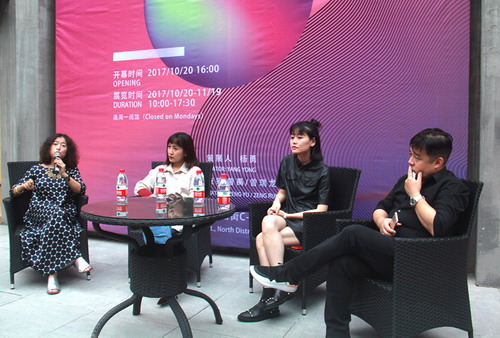
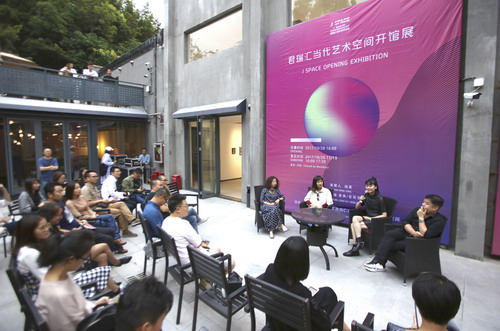
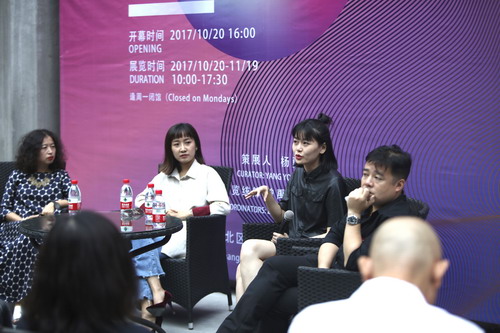
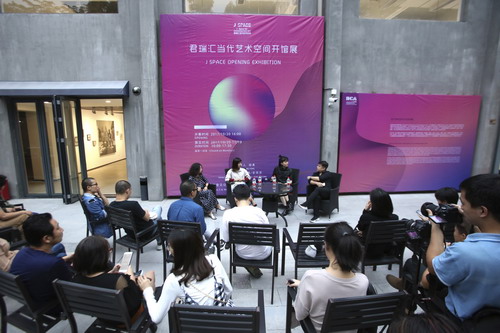
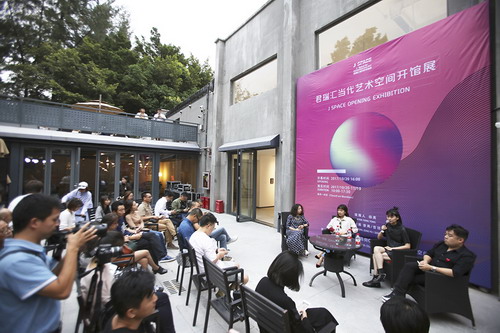
Junruihui is a new contemporary art organization in Shenzhen. We also see some ambition of Junsheng group to promote the development of culture and art through it. We think this is a particularly good thing. Following the various phenomena and steps of cultural and art construction in Shenzhen, we expect junruihui to present more good works and exhibitions to you in the future. Please pay more attention to this new gathering point of cultural and art in Shenzhen. In the morning, my media friends and I said that if you have some interesting questions, you can stay in the afternoon and ask the artists in junruihui. So the next step is the last part of our opening day today. We invited three artists who have works on display in exhibition B to make a simple talk here and share their creations and topics related to the exhibition theme. Let me introduce to you. Next to me is Zhang Xinyi, from Beijing. She is now a doctor of Xu Bing from Yangmei. Her works appear in the three folding designs of our exhibition and are also designed as one of the subway advertisements. Next to her is Lin Shan, a very young artist, and also a "deep second generation". After graduation from GOME, she went to Italy to study, and now she returns to Shenzhen. Then there is Xue Yang, who works in GuanShanYue Art Museum. She is very experienced and has done a lot of creation and exhibition in Shenzhen. It happens that the three of them have some consistency and some difference, so we invite them to talk with us. Next, let's invite Xue yang to share.
Xue Yang:
I think I need to present some essential questions about people in a more three-dimensional way. For example, it's very simple to say that people are born lonely, but it's not a direct translation. I think there are many times that loneliness is optional. It's not just a state, it's a very rational choice. I have to let I am in a relatively lonely and marginal state. In this way, I am independent, critical and selective. For an artist, I think this kind of resistance to himself, reflection on a society as a whole, and some reflections on human nature are all necessary conditions. Because I have done exhibitions in Wuhan this year, in this exhibition, I think there needs to be a three-dimensional statement in a space, so I made a sculpture at that time, but a sculpture is not enough to present such an atmosphere filled thing that I want to create, so I integrated all these things into my exhibition works. Of course, when I moved to a different field, it seemed to bring me some different impacts. It was very good.
Zhang Xin Yi:
In fact, when I started to do this group of works, I very much hoped that it was a kind of communication thing. We didn't want it to be just put in an art gallery to be watched by professionals or judged by media people. I hope it can penetrate into everyone's mobile phone and computer screen. When I first made this work, I didn't really want to do any publicity. I had a good friend, he made an art public number, and I sent him to the Internet. I don't want him to take the initiative to spread and promote it, but I want it to spread automatically. Because I think if this work is recognized by everyone, it must have a certain amount of reading or communication, but I didn't expect that this work is really widely spread. In fact, my acceptance of contemporary art is relatively short. I started to create after I was admitted to the experimental art department of the Central Academy of Fine Arts in 2014. Although my undergraduate course is also related to art, I studied stage art at that time. I really started to create my own things in 2014, and then got some opportunities soon. So I think that although someone will label my works, for example, others may think that my works are very commercialized or popular, but in fact, I don't particularly care about it. It's like the barbaric growth of self in the network and then enter everyone's eyes In the wild. I hope this work is an active thing in the city, rather than only one place or only one or two points in the city can see it. So I think the concept of "city (is) Art Museum" may be to spread art to every corner of the city. Of course, you can use the form of Art Museum exhibition, or the power of media, and then through the sincere recommendation between people, it can be integrated into every corner of everyone's life, and then penetrate into the details of daily life. Including this time, my work was designed as a poster and put into the subway station in Shenzhen. I think it's also very good. It has a certain relationship with the city of Shenzhen to some extent. Because I'm actually unfamiliar with the city, so I think it's put here, and then many people have seen it, indicating that it really has some success in communication. In fact, why did I make this work into a minimalist image at the beginning? One of the reasons is that I found that when classic art pictures are made into the form of pictures that can be read by mobile phones, in order to ensure the quality of the pictures, they are usually relatively large. On the contrary, if the format of a picture is small, it will become very fast in the circulation of the network
Lin Shan:
This exhibition is the first series of works that I have created since I returned to China, which is quite different from my previous works. I think Shenzhen is a strange and familiar city to me. Why do I find it strange? Because it is different from Shenzhen when I was in high school, junior high school and primary school. It has a rapid growth. So when I came back home, I had a strange feeling, maybe familiar, but a little strange. I think I created this group of new works under this feeling, which integrates some memories of my childhood and various emotions, including my cognition of this identity as a female in this society, including a lot of doubts about what kind of body I should be at this age, and so on. Its relationship with the city is that people are a component of the city, and some exchanges generated by the interaction between people, like the vibration wave, are active components in the city, so I would like to continue to grow this series in the future.
Xue Yang:
Maybe my identity is relatively special. I am an Art Librarian working in the art gallery, but I am also an artist who is relatively inclined to contemporary art, so the relationship between me and the art gallery may be somewhat different from that between other artists and the art gallery, and at the same time, there are some differences with a real art librarian, which is a special identity. Just before the lecture, I joked with Lee yew of OCAT and said, "I think I'm a person who tends to be marginal. This kind of edge is in the art gallery, and I will try to marginalize myself. This "Marginalization" does not mean that it is related to power, but that I will appropriately put myself in a relatively independent state, which makes me more comfortable when I create. I'm not bound by any system. I keep a certain distance from the system. Although I'm in the system, I'm connected with other folk art institutions. For example, I also have my own studio in Aohu Art Village, so I have a special independent state like all artists. I feel this state makes me very comfortable. I think the theme of "city (is) Art Museum" is quite interesting. Today, when I was in exhibition hall a, many friends told me that they saw my works in another exhibition hall B. at that time, I didn't go to Exhibition Hall B to see them. When my friends showed me the pictures of the exhibition hall, I suddenly felt that when an artist's works entered a certain space, they were actually not your own works, but the works themselves and all the people who entered the space Product. For the work itself, it no longer belongs to the individual artist. It is a complete form, interacts with all the viewers, and expounds the work completed with all the people. What is an art gallery? I don't think it exists as an objective entity sometimes. I think there is an art gallery in everyone's mind, which may cause us to criticize the insufficiency of the existing art gallery. When we watch the exhibition, we all have our own judgment, good or bad. Because in everyone's mind there is a expectation for the art museum, which may not be a real art museum. For example, if you think of Guan Shanyue Art Museum, He Xiangning Art Museum or OCAT, it may be an art institution, or a collection of some artists' works. This abstract existence is also the concept of a real art gallery. So I think this topic itself is a very open concept, which makes everyone suddenly have a new way to watch the art gallery, which is very good. I have lived in Shenzhen for so many years. I think Shenzhen is very different in recent years. So many art institutions are emerging, so many art galleries are being built, so many artists are appearing frequently. This momentum makes us feel particularly good. It's not necessarily that the real art market is so good. Real artists can survive much better than before, but this rising atmosphere makes me feel that it is a good state. People used to think that Shenzhen is a city without accumulation, but I can feel the presence of friends, children and artists around me. There will be so many people coming to and participating in every exhibition. It's really a very good phenomenon. I'm very optimistic. Although I know there are many problems in it, I think it will be slow Slow resolution.
Yang Yong:
From their different creation and background, the three artists explained their own thoughts on the works and Deconstruction of the exhibition theme. Now we can enter into a discussion link. What kind of questions do you have? We can leave them to our artists and have a simple exchange with you.
Audience:
"City (is) Art Museum" is actually a very inclusive topic. Why is the city an art museum, not a science museum or something else? Maybe we generally think that science museum or other museums will have a relatively patterned thing or a certain knowledge mechanism under a materialistic knowledge system, but relatively speaking, art museum is a deep space that does not have certain inherent things. Generally speaking, the public has a relatively stereotyped expectation for female artists, that is, they may think that more creation of female artists is in accordance with their own identity
Yang Yong:
The concept of "city (is) Art Museum" is established no matter which word "city / is" is removed. This concept contains some expectation and imagination of the city we live in, even some doubt and reflection. In the past ten years, there was a movement of rapid cultural construction in Shenzhen, whether it was physical construction, or various exhibitions, expositions and other activities, which also made many people outside Shenzhen have some expectations or some assumptions about the city. I think it's like the Guangzhou Biennale I participated in in in in 2002, whose theme is "pause". Maybe now we are also Some kind of "pause" is required. Why do I think of this "pause"? Because such a good era can't and won't stop, like rolling wheels, but I think people in the art world, whether from the perspective of the individual artists or from the perspective of public facilities construction, may need to have a kind of vigilance and reflection in the face of such a huge construction and system construction. There are so many art galleries, so many art institutions and so many springing up spaces and galleries in our city. How can we face them? How can we welcome so many possibilities for ordinary people, professional people, and our social institutions and enterprises? We may need time to think about how to build a new art gallery and hold a big opening exhibition? It all requires reflection. I think from my own point of view, I hope to release two kinds of information to you, one is to hope that the public can build a better vision for the city, the other is that we face more rumors or imaginary reflections on cultural information and facilities construction. This is a topic I mainly want to leave to all our friends. Today we are inviting three female artists. After that, we actually have an academic activity, which will invite several male artists. Back to the question just asked, under this topic, how does it relate to your personal creation or personal experience?
Zhang Xin Yi:
I start from my personal point of view as an artist. In fact, I like living in the city. The city is the source of inspiration for my creation. I think some of my other works are also very close to the theme of "city (is) Art Museum". For example, one of my previous works was all furniture in IKEA mall, then it was disassembled and assembled, and then a city was rebuilt. I set up a lot of machinery in it, so that the whole furniture kept moving back and forth, constantly moving, forming a noisy scene. City is my source of inspiration. If I go to a seaside or an island, I think maybe my brain will be empty. Because the city is densely populated, there will be more problems. It will become a center of contradiction and produce a lot of things that can be created. Maybe this is the so-called "where there is a problem, there is art". Another is the issue of women's identity. The first question that many people throw out in chat or interview is: "you are a female artist, how do you think or how do you think, and then what do you think from the perspective of women...". In fact, I don't think I can see the starting point of the female artist's perspective in my works. I may have a little female artist's style from some aesthetic taste. But in fact, from the perspective of the ideas of this exhibition, I hardly think about female identity and personal experience. I like to think about what everyone will think about, that is, I prefer to think about some of you Maybe we can think together, draw some common knowledge, how it condenses into a work that can make everyone have a sense. So many people ask me "how do you think of the identity of female artists", or "how do you get out of this identity", and I say you should stop asking me this question, because when you don't ask me this question, we are absolutely fair. You will not use my female identity to interpret my works. If you can achieve such a sense of fairness, and do not talk about this issue, it may be the greatest fairness.
Lin Shan:
I grew up in Shenzhen and have been living in the city. In fact, from my standpoint, I don't want to leave the city. Because I think you will meet different people in the city. Different environments will help me to accumulate inspiration for my future creation. To answer the question of female artists, I very much agree with the fairness question just mentioned by Zhang Xinyi. Because when I return home, many people will tell me that female artists are actually more difficult. In fact, I also pursue fairness very much, but in my opinion, I will not actually define myself as a female artist, and I also hope that in the future, no matter whether female artists or male artists, there is no need to talk about gender identity differences. Because I think female artists may be more sensitive, but here is also a more individual problem.
Xue Yang:
I often face people asking me, "how are you doing as a female artist?" Because from my previous oil paintings to other forms of works, there is a child, which is also easy to remind others of this gender identity problem, which is always faced with
Junruihui is a new contemporary art organization in Shenzhen. We also see some ambition of Junsheng group to promote the development of culture and art through it. We think this is a particularly good thing. Following the various phenomena and steps of cultural and art construction in Shenzhen, we expect junruihui to present more good works and exhibitions to you in the future. Please pay more attention to this new gathering point of cultural and art in Shenzhen. In the morning, my media friends and I said that if you have some interesting questions, you can stay in the afternoon and ask the artists in junruihui. So the next step is the last part of our opening day today. We invited three artists who have works on display in exhibition B to make a simple talk here and share their creations and topics related to the exhibition theme. Let me introduce to you. Next to me is Zhang Xinyi, from Beijing. She is now a doctor of Xu Bing from Yangmei. Her works appear in the three folding designs of our exhibition and are also designed as one of the subway advertisements. Next to her is Lin Shan, a very young artist, and also a "deep second generation". After graduation from GOME, she went to Italy to study, and now she returns to Shenzhen. Then there is Xue Yang, who works in GuanShanYue Art Museum. She is very experienced and has done a lot of creation and exhibition in Shenzhen. It happens that the three of them have some consistency and some difference, so we invite them to talk with us. Next, let's invite Xue yang to share.
Xue Yang:
I think I need to present some essential questions about people in a more three-dimensional way. For example, it's very simple to say that people are born lonely, but it's not a direct translation. I think there are many times that loneliness is optional. It's not just a state, it's a very rational choice. I have to let I am in a relatively lonely and marginal state. In this way, I am independent, critical and selective. For an artist, I think this kind of resistance to himself, reflection on a society as a whole, and some reflections on human nature are all necessary conditions. Because I have done exhibitions in Wuhan this year, in this exhibition, I think there needs to be a three-dimensional statement in a space, so I made a sculpture at that time, but a sculpture is not enough to present such an atmosphere filled thing that I want to create, so I integrated all these things into my exhibition works. Of course, when I moved to a different field, it seemed to bring me some different impacts. It was very good.
Zhang Xin Yi:
In fact, when I started to do this group of works, I very much hoped that it was a kind of communication thing. We didn't want it to be just put in an art gallery to be watched by professionals or judged by media people. I hope it can penetrate into everyone's mobile phone and computer screen. When I first made this work, I didn't really want to do any publicity. I had a good friend, he made an art public number, and I sent him to the Internet. I don't want him to take the initiative to spread and promote it, but I want it to spread automatically. Because I think if this work is recognized by everyone, it must have a certain amount of reading or communication, but I didn't expect that this work is really widely spread. In fact, my acceptance of contemporary art is relatively short. I started to create after I was admitted to the experimental art department of the Central Academy of Fine Arts in 2014. Although my undergraduate course is also related to art, I studied stage art at that time. I really started to create my own things in 2014, and then got some opportunities soon. So I think that although someone will label my works, for example, others may think that my works are very commercialized or popular, but in fact, I don't particularly care about it. It's like the barbaric growth of self in the network and then enter everyone's eyes In the wild. I hope this work is an active thing in the city, rather than only one place or only one or two points in the city can see it. So I think the concept of "city (is) Art Museum" may be to spread art to every corner of the city. Of course, you can use the form of Art Museum exhibition, or the power of media, and then through the sincere recommendation between people, it can be integrated into every corner of everyone's life, and then penetrate into the details of daily life. Including this time, my work was designed as a poster and put into the subway station in Shenzhen. I think it's also very good. It has a certain relationship with the city of Shenzhen to some extent. Because I'm actually unfamiliar with the city, so I think it's put here, and then many people have seen it, indicating that it really has some success in communication. In fact, why did I make this work into a minimalist image at the beginning? One of the reasons is that I found that when classic art pictures are made into the form of pictures that can be read by mobile phones, in order to ensure the quality of the pictures, they are usually relatively large. On the contrary, if the format of a picture is small, it will become very fast in the circulation of the network
Lin Shan:
This exhibition is the first series of works that I have created since I returned to China, which is quite different from my previous works. I think Shenzhen is a strange and familiar city to me. Why do I find it strange? Because it is different from Shenzhen when I was in high school, junior high school and primary school. It has a rapid growth. So when I came back home, I had a strange feeling, maybe familiar, but a little strange. I think I created this group of new works under this feeling, which integrates some memories of my childhood and various emotions, including my cognition of this identity as a female in this society, including a lot of doubts about what kind of body I should be at this age, and so on. Its relationship with the city is that people are a component of the city, and some exchanges generated by the interaction between people, like the vibration wave, are active components in the city, so I would like to continue to grow this series in the future.
Xue Yang:
Maybe my identity is relatively special. I am an Art Librarian working in the art gallery, but I am also an artist who is relatively inclined to contemporary art, so the relationship between me and the art gallery may be somewhat different from that between other artists and the art gallery, and at the same time, there are some differences with a real art librarian, which is a special identity. Just before the lecture, I joked with Lee yew of OCAT and said, "I think I'm a person who tends to be marginal. This kind of edge is in the art gallery, and I will try to marginalize myself. This "Marginalization" does not mean that it is related to power, but that I will appropriately put myself in a relatively independent state, which makes me more comfortable when I create. I'm not bound by any system. I keep a certain distance from the system. Although I'm in the system, I'm connected with other folk art institutions. For example, I also have my own studio in Aohu Art Village, so I have a special independent state like all artists. I feel this state makes me very comfortable. I think the theme of "city (is) Art Museum" is quite interesting. Today, when I was in exhibition hall a, many friends told me that they saw my works in another exhibition hall B. at that time, I didn't go to Exhibition Hall B to see them. When my friends showed me the pictures of the exhibition hall, I suddenly felt that when an artist's works entered a certain space, they were actually not your own works, but the works themselves and all the people who entered the space Product. For the work itself, it no longer belongs to the individual artist. It is a complete form, interacts with all the viewers, and expounds the work completed with all the people. What is an art gallery? I don't think it exists as an objective entity sometimes. I think there is an art gallery in everyone's mind, which may cause us to criticize the insufficiency of the existing art gallery. When we watch the exhibition, we all have our own judgment, good or bad. Because in everyone's mind there is a expectation for the art museum, which may not be a real art museum. For example, if you think of Guan Shanyue Art Museum, He Xiangning Art Museum or OCAT, it may be an art institution, or a collection of some artists' works. This abstract existence is also the concept of a real art gallery. So I think this topic itself is a very open concept, which makes everyone suddenly have a new way to watch the art gallery, which is very good. I have lived in Shenzhen for so many years. I think Shenzhen is very different in recent years. So many art institutions are emerging, so many art galleries are being built, so many artists are appearing frequently. This momentum makes us feel particularly good. It's not necessarily that the real art market is so good. Real artists can survive much better than before, but this rising atmosphere makes me feel that it is a good state. People used to think that Shenzhen is a city without accumulation, but I can feel the presence of friends, children and artists around me. There will be so many people coming to and participating in every exhibition. It's really a very good phenomenon. I'm very optimistic. Although I know there are many problems in it, I think it will be slow Slow resolution.
Yang Yong:
From their different creation and background, the three artists explained their own thoughts on the works and Deconstruction of the exhibition theme. Now we can enter into a discussion link. What kind of questions do you have? We can leave them to our artists and have a simple exchange with you.
Audience:
"City (is) Art Museum" is actually a very inclusive topic. Why is the city an art museum, not a science museum or something else? Maybe we generally think that science museum or other museums will have a relatively patterned thing or a certain knowledge mechanism under a materialistic knowledge system, but relatively speaking, art museum is a deep space that does not have certain inherent things. Generally speaking, the public has a relatively stereotyped expectation for female artists, that is, they may think that more creation of female artists is in accordance with their own identity
Yang Yong:
The concept of "city (is) Art Museum" is established no matter which word "city / is" is removed. This concept contains some expectation and imagination of the city we live in, even some doubt and reflection. In the past ten years, there was a movement of rapid cultural construction in Shenzhen, whether it was physical construction, or various exhibitions, expositions and other activities, which also made many people outside Shenzhen have some expectations or some assumptions about the city. I think it's like the Guangzhou Biennale I participated in in in in 2002, whose theme is "pause". Maybe now we are also Some kind of "pause" is required. Why do I think of this "pause"? Because such a good era can't and won't stop, like rolling wheels, but I think people in the art world, whether from the perspective of the individual artists or from the perspective of public facilities construction, may need to have a kind of vigilance and reflection in the face of such a huge construction and system construction. There are so many art galleries, so many art institutions and so many springing up spaces and galleries in our city. How can we face them? How can we welcome so many possibilities for ordinary people, professional people, and our social institutions and enterprises? We may need time to think about how to build a new art gallery and hold a big opening exhibition? It all requires reflection. I think from my own point of view, I hope to release two kinds of information to you, one is to hope that the public can build a better vision for the city, the other is that we face more rumors or imaginary reflections on cultural information and facilities construction. This is a topic I mainly want to leave to all our friends. Today we are inviting three female artists. After that, we actually have an academic activity, which will invite several male artists. Back to the question just asked, under this topic, how does it relate to your personal creation or personal experience?
Zhang Xin Yi:
I start from my personal point of view as an artist. In fact, I like living in the city. The city is the source of inspiration for my creation. I think some of my other works are also very close to the theme of "city (is) Art Museum". For example, one of my previous works was all furniture in IKEA mall, then it was disassembled and assembled, and then a city was rebuilt. I set up a lot of machinery in it, so that the whole furniture kept moving back and forth, constantly moving, forming a noisy scene. City is my source of inspiration. If I go to a seaside or an island, I think maybe my brain will be empty. Because the city is densely populated, there will be more problems. It will become a center of contradiction and produce a lot of things that can be created. Maybe this is the so-called "where there is a problem, there is art". Another is the issue of women's identity. The first question that many people throw out in chat or interview is: "you are a female artist, how do you think or how do you think, and then what do you think from the perspective of women...". In fact, I don't think I can see the starting point of the female artist's perspective in my works. I may have a little female artist's style from some aesthetic taste. But in fact, from the perspective of the ideas of this exhibition, I hardly think about female identity and personal experience. I like to think about what everyone will think about, that is, I prefer to think about some of you Maybe we can think together, draw some common knowledge, how it condenses into a work that can make everyone have a sense. So many people ask me "how do you think of the identity of female artists", or "how do you get out of this identity", and I say you should stop asking me this question, because when you don't ask me this question, we are absolutely fair. You will not use my female identity to interpret my works. If you can achieve such a sense of fairness, and do not talk about this issue, it may be the greatest fairness.
Lin Shan:
I grew up in Shenzhen and have been living in the city. In fact, from my standpoint, I don't want to leave the city. Because I think you will meet different people in the city. Different environments will help me to accumulate inspiration for my future creation. To answer the question of female artists, I very much agree with the fairness question just mentioned by Zhang Xinyi. Because when I return home, many people will tell me that female artists are actually more difficult. In fact, I also pursue fairness very much, but in my opinion, I will not actually define myself as a female artist, and I also hope that in the future, no matter whether female artists or male artists, there is no need to talk about gender identity differences. Because I think female artists may be more sensitive, but here is also a more individual problem.
Xue Yang:
I often face people asking me, "how are you doing as a female artist?" Because from my previous oil paintings to other forms of works, there is a child, which is also easy to remind others of this gender identity problem, which is always faced with
|
TEL:0755-26655881 |
EMAIL:info@shangqiart.cn |
|