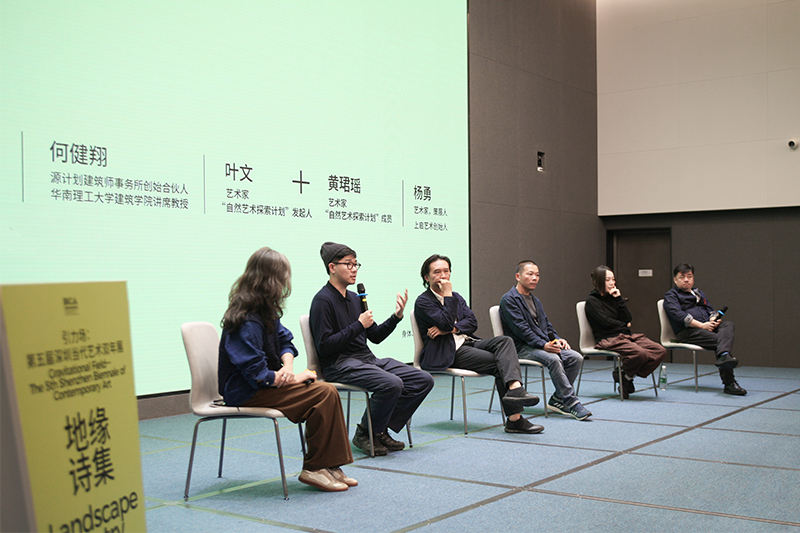
2023年11 月 18 日,第五届深圳当代艺术双年展主题沙龙“身体、行走与文化想象”在大芬美术馆一层报告厅举行。沙龙由广州美术学院艺术与人文学院教授樊林主持,并邀请陈柏麒(写作者,项目 策动者)、何健翔(源计划建筑师事务所创始合伙人,华南理工大学建筑学院讲席教授)、叶文(艺术家,“自然艺术探索计划”发起人)、黄珺瑶(艺术家,“自然艺术探索计划”成员)作为嘉宾,为现场观众呈现有关身体、行走和地方的实践经验。活动由本届双年展策展人杨勇简明开场,沙龙主持人樊林继而通过讲述自己首次来访大芬村的所见所感引入后续分享。
On November 18, 2023, “Body, Walk and Cultural Imagination”, the theme salon of the 5th Shenzhen Biennale of Contemporary Art, was held in the 1st-floor conference hall of Dafen Art Museum. Moderated by Fan Lin, Professor at School of Arts and Humanities, Guangzhou Academy of Fine Arts, the salon invited four guests – Chen Baiqi (writer and curator), He Jianxiang (Founding Partner of O-Office Architects and Chair Professor at School of Architecture, South China University of Technology), Ye Wen (artist and initiator of Nature Art Exploration Program) and Huang Junyao (artist and member of Nature Art Exploration Program) – to share with the audience practical experience about body, walk and locality. The event was briefly introduced by Yang Yong, curator of this year’s biennale, and then moderator Fan Lin related to what she saw and felt during her first visit to Dafen Village as a lead-in to the sharing afterwards.
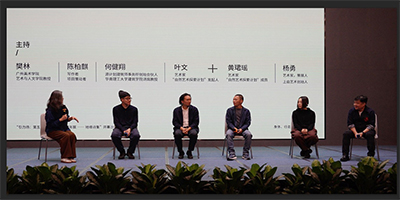
下文为沙龙内容节选,文本经由上启艺术团队编辑整理,并由主持与嘉宾分别审校,配图均由讲者惠允。
The following text is extracted from the content of the salon, edited and organized by the exhibition team and reviewed respectively by the moderator and guest speakers. The pictures in use are all approved of by the moderator and speakers.
一个问题的引入
The Introduction of a Question
樊林:在地究竟在哪里?
Fan Lin: Where Is the Localness Located?
这是我第一次来大芬美术馆,一句话,我发现只有用肉身去感受它,才知道什么叫大芬村,什么叫大芬美术馆。今天来的路上,突然想起“布吉”(编者注:布吉隶属深圳龙岗,为大芬村所属辖区)这个词好像曾经紧密,但很明确,之前没有来过这里。后来我想起来,大学毕业的时候特殊原因,中山大学毕业的同学被分到布吉小学教书。在我和舍友的通信里布吉小学作为地址,可能保持了10年,所以我突然意识到这个词一直在我的身体里面,只是我没有到过这里。
This is my first time here in Dafen Art Museum, and I find that only when you feel it physically will you know what Dafen Village or Dafen Art Museum is. On my way here, it hit me that the word “Buji” (Editor’s note: Buji is part of Longgang District, Shenzhen, and Dafen Village is part of Buji) seemed quite familiar to me for a time, but I’m sure I hadn’t been here before. A while later I recalled that a dormmate of mine had been assigned to a primary school in Buji for special reasons after graduating from Sun Yat-Sen University. The school haunted the envelopes as an address for the letters we wrote to each other for perhaps ten years, so I suddenly realized that the term is in the depth of my memory but I just hadn’t been here before.
车进了村口,我下车在村里走走,发现了很多风景。有一条标语写的是“除了画画,不会别的”,世界上很多画家会这样说,但大芬村的店主们也这样说的时候,他们修正着我们对艺术概念的理解。
Upon arrival at the village entrance, I got out of the car for a walk around and found many sights. For example, I saw such a slogan: Painting is all we are capable of. Many painters in the world would say it, but, when the shop keepers in Dafen Village say it, they are rectifying what we make of the concept of art.
实际上,今天我和各位嘉宾呈现给大家的演讲共同要做的事情,就是通过对物理空间的再次感受,也通过观察和了解不同的工作方式、思考,最终填补自己的空白,将一段历史变化描述出来。同时也希望通过讨论一些概念,重新修补社会的联系。我们强调肉身,是因为进入当代艺术以来,肉身的重要性放在了更前面。无论我们简单说作品尺度、媒材,还是更多的家国情感、空间、物理、历史、社会,所有这些问题都由肉身体验串联。
Today, as a matter of fact, what our guests and I try to do through talks is fill in some blanks of ours and give an account of a change in history by revisiting the physical space and observing and learning about different ways of working and thinking, and we also hope to fix social relations by discussing some concepts. We put emphasis on the body because it comes first in contemporary art from the start. From simply the dimensions and medium of a work to more complex issues including patriotism, space, physics, history and society, all of these have to do with physical experience.
这些年,我作为一个观察者,也希望能够对整个我们生活的大的区域的艺术生态有所了解,能够描述。那么在此,我想带出的首先一个问题就是“在地究竟在哪里?”。“在”可以是一个中国传统概念的“在”,也可以是一个西方哲学概念的“在”,当我们在某一个地方的时候,究竟是用哪一些语言、哪一些思考,才能对应到这个“地”?
Over these years, as an observer, I also want to learn about and be enable to describe the art ecosystem of the big region where we live. So, I’d like to introduce my first question here: Where is the localness located? “Localness” means the state of being local, in which “being” could be a traditional concept in China or a concept in Western philosophy, so, when we are being somewhere, what languages and thinking should we employ to really be “local”?
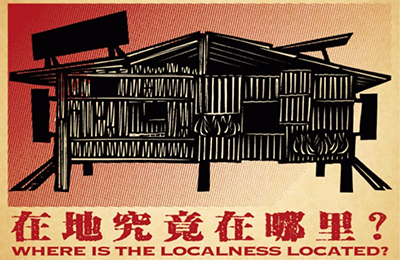
《在地究竟在哪里?》,问题小组:刘庆元×樊林,视觉设计:郭图图
Where is The Localness Located?, Question Squad: Liu Qingyuan × Fan Lin, visual design: Guo Tutu
关于樊林
广州美术学院艺术与人文学院教授,主要致力于西方美术史教学、研究、写作;当代艺术批评,展览策划。以“德国新表现主义绘画”为题入选中国美协海外研修计划,赴德国访学。受邀赴澳大利亚、匈牙利、德国策划展览、讲学,受邀出席挪威双年展担任观察员。曾担任“连州国际摄影年展”学术委员、单元策展人,“深港城市\建筑双城双年展”板块策展人,“AAC艺术中国•年度影响力”初评评委,坪山美术馆理事会理事,第七届“广州三年展”学术委员。
About Fan Lin
Fan Lin is a professor at School of Arts and Humanities, Guangzhou Academy of Fine Arts, art critic and curator. She’s dedicated to teaching, research and writing on Western art history, and her study of “German neo-expressionist painting” earned her the chance of an academic visit to Germany as a member of China Artists Association’s overseas study program. She has been invited to curate exhibitions and give lectures in Australia, Hungary and Germany, and was commissioned as an observer for the 6th Momentum Biennial in Norway. She once served as an academic committee member and section curator of Lianzhou International Photo Festival, a section curator of Shenzhen-Hong Kong Bi-City Biennale of Urbanism\Architecture, a preliminary judge for Award of Art China, a council member of Pingshan Art Museum and an Academic Committee member of the 7th Guangzhou Triennial.
分享节选
Excerpts from the Talk
陈柏麒:作为研究者、居住者和行动者的身体
Chen Baiqi: The Body of an Observer, Inhabitant and Do
我目前在做研究和写作,同时也供职于自己创办的一家从2015年起根植于潮汕的非盈利机构——“观潮”,陆续做了很多孵化、呈现,包括地方独立影展、旅行相关的项目。在研究的过程中,我一直尝试着理解和物件的接触、人的接触、空间或环境的接触中,我的身体到底意味着什么,我为什么要把我的身体投注到当中?
Apart from doing research and writing, I’m also serving now in Kwan Teo, a non-profit institution based in the Chaoshan area, which I founded in 2015 with friends to incubate and present projects such as an independent regional film festival and travel-related projects. During my research, I always try to understand what my body really means and why I have to devote my body when I connect to an object, a person, a space or environment.
我过去四、五年持续在做的研究可以从“洋楼”说起。“洋楼”是潮汕本地的叫法,这样一些中西结合的结构大概建于晚清1870年左右。然后到1939年,也就是日本侵华军队正式登陆潮汕时,这样一批建筑就基本终止了相关修建工作。所以在这短短70年时间里,潮汕人在当地和移民去到的地方所修建的一些看起来奇奇怪怪的房子,从类型学上说,可能是某种殖民地风格的建筑,我们可以在上面看到一些所谓的晚期维多利亚风格,但其实大部分时候,我们只能通过一些边边角角,去回溯那个时候世界主义对潮汕人的影响,去思考这些人到底是怎样从来来往往漂泊的生活当中去认知、获得,并将这些东西带回原乡。
Over the last four or five years, I’ve been researching a vernacular kind of Western-style buildings in the Chaoshan area, or Yanglou as is locally called, structures built in the late Qing dynasty around 1870 that combine Western and Chinese elements. In 1939, the invading troops of Japan landed on the region, which basically put an end to the construction of such buildings. Typologically, the odd-looking houses built in the short span of 70 years locally by Teoswa people or where they migrated to may follow some colonial styles, such as the Late Victorian style, but most of the time we can only study the remainder for the then influence of cosmopolitanism on Teoswa people and how they perceived and acquired these things in their drifting life and brought them back to the hometown.
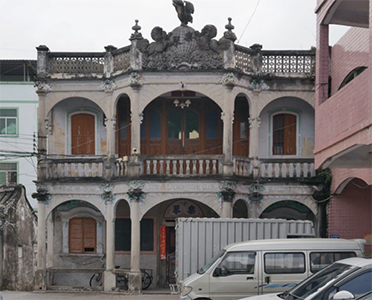
建于1887-1939年间的洋楼 Yanglou built between 1887 and 1939
这些建筑大部分藏身于乡村当中,所以过去四年多的时间里,我基本上只能靠腿去走,靠嘴去问,因为没有记载也没有人会告诉我这些房子在哪里,所以我就一个村一个村去探索,然后慢慢去发现、辨认、记录
Most of these buildings are now hidden in rural areas, so, for the past four years or so, I could only investigate by foot and by asking around for directions with my mouth. No record or informant can tell the whereabouts of the houses, so I had to search villages one by one for later discovery, identification and recording.
刚才樊林老师有提到说“在地是什么?”,其实我在做这件事情时,第一个问我自己的问题就是“这个地方是什么?”。
Prof. Fan Lin just mentioned what the “localness” is, and, when I was doing this research, the first question I had for myself was: What is this place?
大概在2019年的时候我做了一个片子,也因为这个片子我在樟林这个地方不断游走、去看、去发现、去理解建筑在今天扮演什么样的功能。实际上,这些房子无论它今天是什么功能,它只要还存在,就仍然容纳了大量还未消失的关系,比如新加坡的亲戚会知道在故乡还有个老房子,而在这里的人还会惦念着泰国、马来西亚的家人。一旦这个房子消失,这些实际上存在的关系也会随之消失,所以对我来说,这些房子是一个很重要的当下的关系容器,当然,它过去肯定也是一种家庭关系的载体或解决家庭问题的主要办法。
In 2019, perhaps, I made a film, and, to make it, I kept wandering around Zhanglin to see, find and understand the role the buildings play today. In fact, regardless of their role today, as long as they exist, they still contain a lot of relationships that haven’t been broken off, like a relation in Singapore may know he still has an old house back in his hometown and people on this side may still miss their families in Thailand or Malaysia. Once every such house is gone, its share of these actually existing relationships will also come to an end, so, from my point of view, these houses are very important containers of relationships and, in the past, they certainly were also carriers of family relationships or a main solution to family problems.
我尝试着去理解以樟林这座港口为起点,从那个时代开始的,潮汕人大规模的背井离乡,他们去到能够想象的最遥远的地方扎下根来,然后又在过去100多年间陆陆续续回到这里,像我一样地观看和居住。这便是我2019年、2020年做的一个工作。
I tried to understand the phenomenon of Teoswa people leaving their homeland in great numbers from that period and from this port of Zhanglin, settling down at the furthest possible places they could reach, and then returning one after another after about 100 years to see and live in this place the way I do. That is what I was doing in 2019 and 2020.
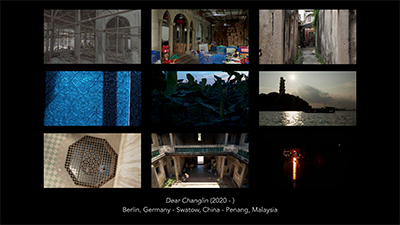
《亲爱的樟林》,影片静帧 Dear Changlin, film stills
后来我意识到我不只是想看这些建筑,我在乎的是住在这些房子里的人。所以在认识了很多住在这些房子里面的老人之后,我选定了其中一位作为我长期采访的对象。然后在去年,我又意识到这些房子无论我怎么去观看,这些住在房子里的人无论我有多频繁地去接触,我都无法真正进入并理解房子。所以去年11月后,我寻找了一座已经荒废多年的房子,自己住进去,尝试去模仿前人的方式生活。
Later I realized that not only did I want to see the buildings, but I also cared about the people who live inside. So, after I got to know many elderlies who lived in these houses, I picked one of them as the subject of my long-term interview. But then, last year, I realized anew that, no matter how I look at the houses or how frequently I contact people who live inside, I cannot really get into and understand the houses. So, from November last year, I started to live in a long-abandoned house I had found and tried to live the way our forefathers used to.
从我居住在一个房子,再到接触一些人并理解一个地方之后,我也开始意识到了这个地方它实际上像一个河流,或一片流域一样,和其它的物一起,千沟万壑地被勾连着。我有一段时间会很好奇,我们所谓的韩江流域,所谓的潮汕平原到底由什么样的物构成,它自古以来是什么样子?我的先祖们怎样从山里走到海边,他们在100多年前走了什么样的路,坐了什么样的船?
From living in a house to connecting to some people and then understanding a place, I also started to realize that this place is actually like a river or drainage basin that is linked with everything else in the form of various ravines. I was wondering for a time what our Han River basin or Chaoshan Plain is really made of, what it was like in different periods in history, how our ancestors traveled from mountains to the coast, what paths they took about 100 years ago and what boats they sailed.
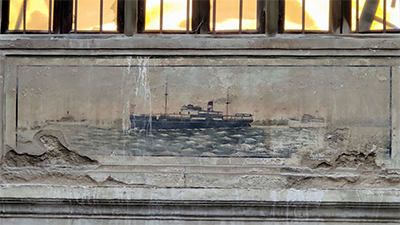
荒废洋楼内的壁画 A mural in an abandoned Yanglou
2022年7月,我决定做一件事情,这个项目叫“第29次穿越河流”。从梅州走路到韩江出海口,7天的时间,200多公里的路,这个过程中遇到各种各样过河的机会,有过桥的、搭船的,这其中既有捕鱼的船、捕贝壳的船,也有渡船、货船、运水泥的船。也是在这个过程中,我在思考为什么要做这件事?因为对我来说,一个地方的人,无论是潮汕还是其它某个地方的人,其实都是在不断流动、不断穿越的过程中因为和一些东西产生了距离,所以会去认识这些东西,并追问这些东西是什么,这也便意味着——询问自己从哪里来,自己是谁?在这样来来回回的过程中,不断确认自己究竟是什么,自己的原乡是什么,也逐渐认知、确信自己的身份。
In July 2022, I decided to carry out a project called “The 29th Time to Cross the River”. It takes seven days to travel from Meizhou to the Han River estuary on foot. It’s a journey of over 200 kilometers, where there are a good many chances to cross the river, mostly bridges and boats, such as fishing boats, shell catching boats, ferries, cargo ships and cement carriers. And, in this process, I was thinking about why I had to do this. The way I see it, the continual moving or traversing of people from a place, the Chaoshan region or elsewhere, is actually distancing them from something, and that’s when they would start to know those things and ask about them, which is equal to asking where they are from and who they are. Such a to-and-fro process can help affirm over and over who they really are and where they are originally from, so that they can understand and be sure of their identity step by step.
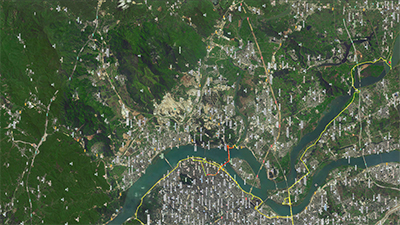
韩江潮州段,黄线示意当时的行走路线,红线则为过河路线
The Chaozhou section of the Han River, the yellow line for the walking route at the time and the red one for the river-crossing route
今年我又在行走,做类似的事情,也去另外的地方,但这次对我来说是非常重要的经验,因为这条路线其实我开车来来回回没有10次也有8次,但只有真正用脚走到上面,一条村子一条村子去看,我才开始意识到山是什么样的山,河是什么样的河,以及人是怎样沿着河去生活,怎样从这里去到那里。这一切都没有想象中那么理所当然。
I also walked this year, did something similar and visited some other places too, but this walk has brought me very important experience. It was a route I had traveled ten or at least eight times by car, but only when I walked on it and visited one village after another did I start to realize what the mountains and river really look like, how people live along the river and how they get from here to there. None of these are as what they are meant to be as we have imagined.
对我来说,其实怎样参与特别要紧。我一直相信那些房子不是无缘无故被塑造的,而是源于我们对于一些东西的理解、想象,继而塑造出一些意义,这些意义在传递下去之后,大家从这个意义之上,又积累出了一些东西,才变成了这样的一些房子。所以,踏入那个地方,住进那个地方,理解那个地方,是一切的起手式。哪怕是对于一些遥遥无期的工作,这些起手式也是应该去做的事情。这也是今天想跟大家聊的,把身体丢到现实空间里面的一些必要性。
The way I see it, how we engage is particularly important. I always believe that those houses were built that way for a reason. The source may be our understanding or imagination of something, which generates some meanings, and the meanings are passed down and lead to the accumulation of something, embodied by such houses. So, to step into and live in the place and then understand it is but the beginning of everything. A beginning that is always necessary even though there is still a long way to go. This is what I’d like to share with you guys – the necessity to place the body in real space.
关于陈柏麒
生⻓于广东澄海,陈柏麒是一名写作者、档案工作者和项目策动者。他毕业于芝加哥艺术学院,获现代艺术史及艺术行政双硕士学位。目前他仍是英国皇家艺术学院建筑学院的博士候选人,从事建筑人类学研究。柏麒以策划艺术项目为生,曾先后供职于香港艺术节、芝加哥美术馆、OCAT深圳馆和华侨城创新研究院。而推动地方电影创作是其艺术策动工作中的核心板块,2015年他与好友一同创立了呈现海内外潮汕电影的“观潮影展”,并艰难维持至今。
About Chen Baiqi
Born and raised in Chenghai, Guangdong, after graduating from Hong Kong Baptist University, Chen Baiqi received a dual master's degree in Modern Art History and Art Administration from the School of the Art Institute of Chicago in 2019. He is currently a PhD candidate researching architectural anthropology at the School of Architecture, Royal College of Art in London. He is a writer, curator and documentary filmmaker. As an art project curator, he worked successively with Hong Kong Arts Festival and at the Art Institute of Chicago, Shenzhen OCT Contemporary Art Terminal and the OCT Innovation Research Institute in Shenzhen. To promote vernacular film art is a key part of his art curatorial work, so he cofounded Teoswa International Film Art Festival in 2015 with his friends to screen Teoswa films from China and abroad and has maintained it through tough times.
何健翔:造物、风景、建筑的身体性
He Jianxiang: The Bodiliness of Creations, Scenery and Architecture
建筑是一个并非像艺术那么个体化,或者可以在某种形式上形而上地去思考的存在,建筑每天面对的是各种具体的需求。在这种基础上,作为建筑师,我对自己的要求,或者说我现在进行建筑教学时,对学生的要求,是你必须对你周围所建出事物的状态做更深入的思考,或者说,找到事物它们之间的根源。从我的角度来讲,首先要思考的问题便是——今天我们的城市、空间,为何发展到如此的状态,这种状态的根源在哪?
Architecture is not as individualized as art and it defies all metaphysical thinking as what it faces everyday is all sorts of concrete needs. Based on this, my requirement for myself as an architect or for my students whom I teach architecture is that you must do deeper thinking over the state of everything built around you or find the origin of it. From my point of view, the first question to think about is: Why would our cities and spaces develop to their current state, or what’s the origin of such a state?
首先是景和物的关系。
First of all, the relationship between scenery and objects.
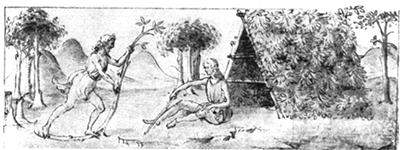
《建筑绘画论》,安东尼奥·埃维里·菲拉里特,图源:网络
Trattato di Architettura, Antonio Averlino Filarete; image from the Internet
我相信在人类比较早的时候,没有分离,景和物是一体的,人所见到的物体全部是景,景也全部是人所触及到的物。那么很快,人类就开始用物料去搭建、构建,或者说,开始造物。而开始造物的这个过程中,且在人造物里,建筑是最复杂,或尺度最大,各种社会组织也最综合的一类。所以,这件事情实际上也让人类自己存在或生存的空间开始与外界自然产生分离。这种分离随着工具和物件的复杂化之后,越发明显,人的主体性变得特别强烈。加上后续工业革命所带来的效率,人类能够开始利用或者操控以前地球所吸收的太阳能量,并且把它转换成生产,这个时候,城市实际上就远离了旧有的,用人工来生产和构筑建筑、空间的方式。而到了现代主义之后,伴随大型机器、工具的出现,建筑实际上已脱离原来和人身体的关系,它大量依靠巨大的机械化和标准化工厂生产来达成。在一个非常极端,在历史上也很有名的德国现代主义建筑师所设想的现代主义的城市里,以前城市和乡村的共存,或者人造物和风景并存、相对的状态,完全被工具化的人造物所取代。
I believe that, in earlier times, we didn’t separate scenery from objects. Every object we saw was scenery and all scenery was objects we encountered. But soon, we began to use materials to build, construct or create things. And, after we began creating things, among artifacts, architecture is the type that is the most complicated or largest in size and involves the most comprehensive social organizations. So, this actually also separated our living or survival space from nature outside. This separation became more obvious with the complication of our tools and objects, and greatly intensified the subjectivity of mankind. And, thanks to the efficiency brought by the later Industrial Revolution, humans have learnt to use or manipulate the solar energy the earth absorbed in the past and turn it into productivity, which means that the way of producing and constructing architecture and space with human labor has in fact been obsolete in cities. Then, in this age of modernism, the invention of large-scale machines and tools has actually detached architecture from its original relationship with the human body, given that most of it is currently produced through large-scale mechanization and standardization. In a modernist city envisioned by an extreme yet famous German modernist architect Ludwig Wilhelm Gilbert, the coexistence between cities and villages or between artifacts and scenery in an opposite relationship is completely replaced by tool-ized artifacts.
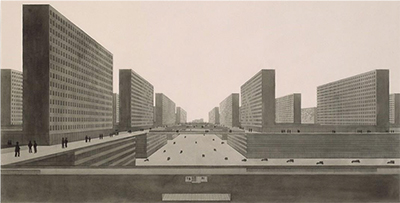
《高层城市》,路德维希·希尔伯赛默,图源:Art Institute of Chicago
Hochhausstadt, Ludwig Wilhelm Gilbert; image © Art Institute of Chicago
在这个基础上,生产不断发展之后,便造就了德波所说的,整个我们所生产出来的物,加上被描述和传播的信息,或者对未来之物的期待,共同形成了一个 “景观社会”。风景本身既是生产的结果,又是再生产所必须的条件,人所看到的、所拥有的、所想象的,全部被包含或被包裹在所谓的景观社会里。
Based on this, as production continues to develop, we’ll have what Guy Debord calls a “society of the spectacle”, composed of everything we produce, the information disseminated that describes the things or the expectations of things in the future. Scenery is not only the outcome of production but also the condition necessary for the following production. Everything we see, possess and imagine is included or covered by the so-called society of the spectacle.
反观我们的传统,这种人造物和自然的分离反倒不如西方那么明显,而是始终在一种相对的状态,我们的房子、空间、物件,实际上始终保留着跟自然景物的一种有机关系。即便谈到我们的城市尺度,自然和人造之间的关系实际上也不是完全分离,而是始终有机地交织在一起——这就是我们的城市传统。但很可惜,众所周知,在我们不顾一切或毫无反思的状态下,引入现代性的生产后,生产极大改变了我们的城市、乡村,还有我们生活的一切,就等于我们的工作、生活都被包裹在一个个标准化的方格、单元或产品里,几乎再也没有办法和土地或自然发生任何关系。
In Chinese tradition, however, artifacts and nature are separated not so obviously as in the West, but always stay in an opposite relationship. Our houses, spaces and objects actually maintain an organic relationship with natural sights all along. Even when it comes to the size of our cities, nature and artifacts are not completely separated, but always intertwined organically – this is the tradition of our cities. But, sadly, as we all know, modern production, since it was introduced regardless or without reconsideration, has greatly changed our cities, villages and everything in our life, which means that our work and life are all wrapped in standardized squares, units or products one after another and that it’s basically impossible for them to connect with land or nature any more.
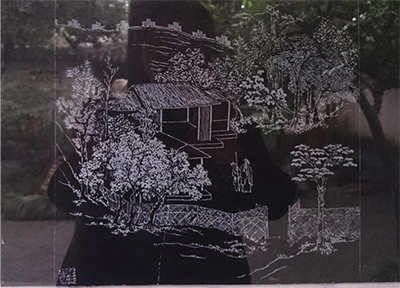
中国传统意向中的风景
Scenery in Chinese traditional imagery
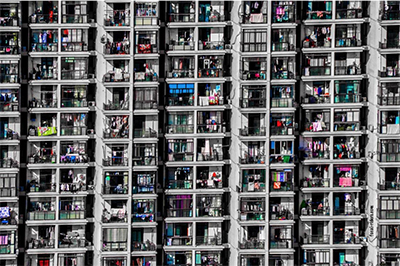
《Den(c)ity》,Régis Jouvinier,图源:网络
Den(c)ity, Régis Jouvinier; image from the Internet
我自己成长于粤语区,在这里过去那种乡土地理的情节特别深,但同时,这里如今也会每天面对空间生产的急剧要求,在这个情况下,我们必须思考如何去处理、应对。我们和广东时代美术馆在展览空间设计上的几次合作便是思考后的实践结果。
Raised in a Cantonese-speaking region, I have a real complex about what our native place was like in geography in the past, but, in the meantime, this place faces a sharp rise in the need for spatial production, which forces us to think about how to deal or cope with it. The several collaborations between us and Guangdong Times Museum in the spatial design of exhibitions are fruits of consideration in practice.
时代美术馆所处的城乡结合部有着各种肌理,城中村、杂散的工业厂房、新住宅小区、新楼盘等,大概在9年前的一次展览中,这些便成为了艺术家所共享的、可以直接取用的创作素材。大概有10多件的艺术创作被我们安放到了一个叫“美术馆街道/街市美术馆”的空间概念里,我们把所有这些取材于城市的物件,比如行道树、不锈钢4轮车,还有拱门、街巷或一些二次创作的物件等,移置到美术馆内部展厅中的一个“街道”空间。同时在展览过程中,美术馆还组织了多场公共活动,比如广场舞、集体的瑜伽课程,这些活动也直接在“街道”中进行。
The urban-rural fringe area where Times Museum is situated has a variety of fabrics: urban villages, scattering industrial premises, new residential communities, new property developments and so on, which became sharable, readily available material for artists for an exhibition about nine years ago. We placed about ten pieces of art in a conceptual space called “gallery street / street gallery”. We transplanted all the objects previously from or based on the city, such as the sidewalk tree, stainless steel four-wheeler, arched door, alley and some modified objects, to the “street” space inside the exhibition hall of the museum. During the exhibition, the museum also organized a number of public activities, including square dancing and collective yoga courses, directly in the “street”.
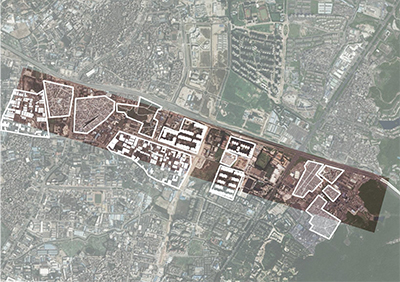
城市肌理的拼贴
A fabric collage of the city
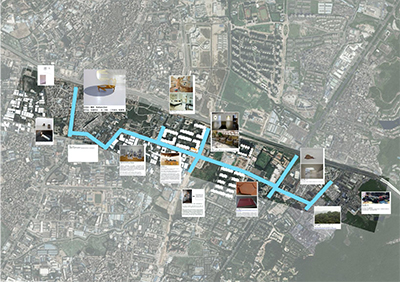
美术馆成为城市?
An art museum as a city?
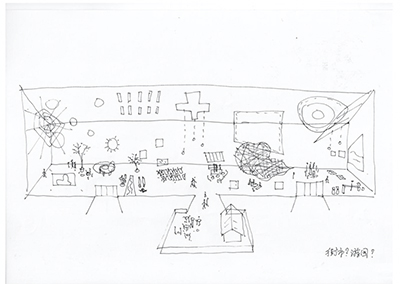
街市美术馆
Street gallery
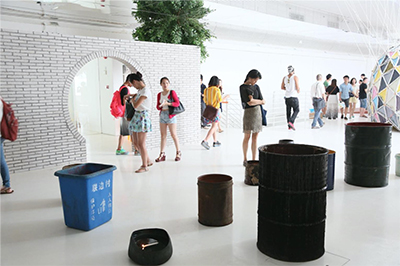
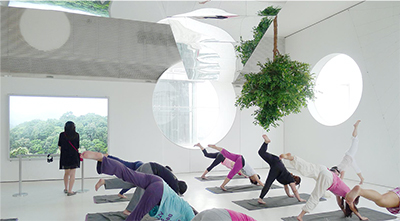
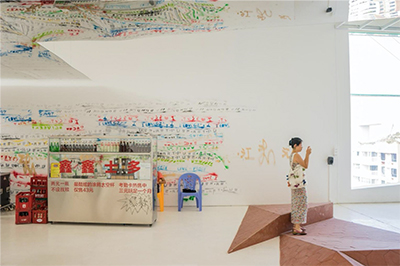
时代美术馆展览《不想点别的事情,简直就无法思考》现场,何健翔/源计划作为空间设计参展
Exhibition Views of You Can Only Think about Something if You Think of Something Else in Times Museum, He Jianxiang / O-Office as the spatial designer
在这个项目之后,我们与时代美术馆合作了另一个展览《无用之用:三角洲行动#4 之建筑在行动》。基于展览议题当中关于人与空间、城市与环境关系的讨论,也基于当时“大流行”的状况,我与另外两位分别来自日本、欧洲的受邀建筑师,通过线上的讨论,确认了展览最终的呈现方式——一个建造在长条形展览空间中的迷宫。迷宫的实际做法,最终被落实到一种材质非常粗犷的空心砖,并且通过由砖块将长条展览空间分隔成不同尺度、大小的三角形空间,给进入内部的观众带来一定迷失感,但又不至于产生让观众过于恐惧的压制感。而在迷宫之外,我们也觉得对于观众,在这种半封闭或者封闭的观展过程中,需要某种形式的逃离,比如往上走,走高一点,爬高一点,那么最终,可能还会想通过一个跳跃的身体动作,来释放被压制或被压抑的那部分情绪。于是,我们还做了另一组放置于玻璃盒子展厅的构筑物作品,“得了塔(Delta)”,它实际上是希腊字母,几何学中也可写作三角形(Δ)。
After this project, we continued our cooperation on another exhibition, Uselessness as Usage – Operation Delta #4: Architects in Action. Considering the exhibition’s exploration of the relationships between man and space, cities and the environment, during the pandemic at the time, we discussed online with two invited architects, respectively from Japan and Europe, for the ultimate form of the exhibition – a maze built in Time Museum’s oblong exhibition hall. The maze was realized by using a very rough kind of hollow bricks to divide the oblong space into triangular cells of different sizes, in order to give visitors a certain sense of loss which made the space acceptably oppressive. And, outside the maze, we felt that the visitors, after experiencing the semi-enclosed environment, would need to escape in some way, like going up or climbing higher for, perhaps, a final jump to release the suppressed part of their emotion. So, we also designed a structure called Delta, made a few and placed them in the glass-box exhibition space of the museum. Delta is actually a letter in the Greek alphabet, and represented by a triangle (Δ) in geometry.
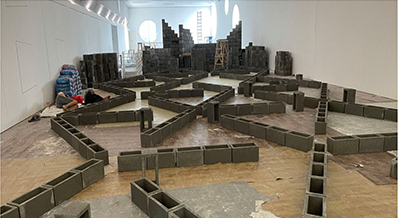
时代美术馆展览《无用之用:三角洲行动#4 之建筑在行动》搭建现场,何健翔/源计划,《迷宫》
Construction site of Uselessness as Usage – Operation Delta #4: Architects in Action in Times Museum; Maze, He Jianxiang/O-Office
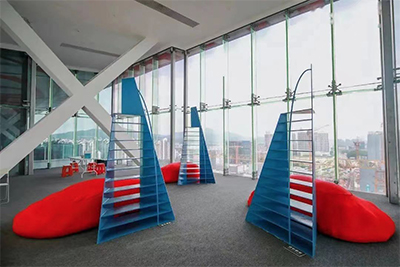
时代美术馆展览《无用之用:三角洲行动#4 之建筑在行动》开展现场,何健翔/源计划,《得了塔》,图源:时代美术馆
Exhibition site of Uselessness as Usage – Operation Delta #4: Architects in Action in Times Museum; Delta, He Jianxiang/O-Office, image © Times Museum
不管我们的迷宫,还是这个构筑物的名字和它的形状,都在呼应“三角洲行动”这个计划。最终,我们希望可以把自己的一些思考转为现实行动,也希望能让更多人同样去思考这些问题。
Our maze, the name of this structure and its shape were all echoing the project “Operation Delta”. Ultimately, we hope that we can put some of our thinking into practice and even inspire more people to think about these questions.
关于何健翔
源计划建筑师事务所创始合伙人,华南理工大学建筑学院讲席教授。何健翔早期在欧洲留学工作,2007年回到广州,与蒋滢组建了源计划建筑师事务所,正式开始其在南中国城市的独立建筑实践。源计划试图将多元文化和价值与地域性的建筑实践结合,都市更新保护和新集合居住形态是其近年工作的重点。源计划独特的地域性实践获国内外专业建筑奖项,包括RIBA2021英国皇家建筑师学会国际卓越建筑奖,ARCASIA 2020和2022两届亚州建筑师协会金奖,AR 2017《建筑评论》New into Old建筑更新奖和瑞士BSI 2016建筑提名,以及2020 首届三联人文城市建筑大奖。
About He Jianxiang
He Jianxiang is a Founding Partner of O-Office Architects and Chair Professor at School of Architecture, South China University of Technology. In 2007, he returned to Guangzhou after years of study and work in Europe and co-founded O-Office Architects with Jiang Ying, embarking on a career in independent architectural design and research in southern Chinese cities. O-Office Architects is interested in integrating diverse cultures and values with regional architectural practices. Urban renewal and re-intervention of collective living forms are the recent focus of O-Office’s work. Its experimental regional practice has won important architecture awards both in China and abroad, including RIBA 2021 Award for International Excellence, Gold Awards of ARCHASIA 2020 and 2022, the Architecture Award of the 1st City for Humanity Award in 2020, Highly Commended in AR New into Old Awards in 2017 and nomination of the BSI Swiss Architectural Award in 2016.
叶文、黄珺瑶:身体、自然与遐想
Ye Wen, Huang Junyao: Body, Nature and Imagination
叶文:过去三年多有很多事都颠覆了我们过往对世界自以为坚固的认知,也改变了我们看待人或物的方式与角度。我大概是在今年3月份时产生了一些想法,觉得在专业上,是不是可以找一种相对不太一样的工作方法,或者是不是可以绕开现有的艺术体系,去寻找一些新的可能性。而现实方面,我的诉求是,希望走出现实的困顿与社会性的伤痛。基于个人成长经验以及对当下艺术现状的反思,我渴望回到艺术开始的地方,走进自然、荒野。
Ye Wen: Most of what happened in the past three years have upended our previous perceptions of the world, which we thought were solid, as well as our ways and angles of looking at people or objects. It was probably in March this year when I came up with some ideas, thinking that I should try a different approach to my work or find some new possibilities that steer clear of the established system of art. In reality, I needed to get out of the current plight and the society-wide suffering. My personal growth experience and my reflection on the current situation of art filled me with a longing to go back to where art started, nature or the wilderness.
我作为“自然艺术探索计划”的发起人,和四位受邀的艺术创作者,皆在深圳生活了20 年以上。我们的工作方法最重要的有三个特点,一个是不设预期:我们进入到自然当中之前,并不去预测我们今天要做什么,或者我们能做成什么。第二是:我们跟邀请的艺术家之间,在创作上不会去做一个非常明确的沟通,而是更倾向于一个根型的发展或生长,也就是每个人都不知道彼此在做什么,或者说彼此能做成什么。另外,也是我个人比较强调的一点——我们不做社会学的调研。我有两组作品是在深圳梧桐山实施的。其中一件,是在水里随意捡了一个石头,用边上的藤条把它悬挂起来,自己静坐在边上,用镜头对准它。在风的作用下,石头不停跟水面发生接触,然后离开。另一组作品,是我带着我孩子去玩的时候,发现他的一些动作非常自然,便把这些动作记录下来,同时邀请山上碰到的一些孩子,在水上拍打。他们拍打水面的节奏,也是在那个环境中他们心里想传达的节奏。我的兴趣点主要在两方面:一是在近似的自然环境中,不同的人产生的不同的身体机能与情绪反应,同时他们又是如何把这些反应传递给外部;二是人的身体和行为对时间、空间和物体的形态进行的一些短暂且细微的干预。
As the initiator of Nature Art Exploration Program, I invited four artists, who and I have all lived in Shenzhen for over 20 years. Our approach to work has three most important characteristics. First of all, we don’t plan beforehand: before stepping into nature, we don’t predict what we are going to do today or what we can accomplish. Second, our communication with the invited artists won’t cover anything definite about each other’s creation, but, like the roots of a plant that grow separately, we have no idea of what each other is doing or what each other can accomplish. The last one is a point I’d personally like to stress: we don’t do sociological research. Two pieces of mine were implemented in Wutong Mountain, Shenzhen. In one of them, I collect a random stone from the water, hang it on a bough with a rattan I’ve found nearby, sit quietly by its side and aim my camera at it. The wind keeps the stone moving a bit into and off the water. Another piece was inspired by some of my kid’s very natural movements when I took him there. I recorded them and also invited some kids we had met in the mountain to beat the water. The tempo at which they beat it was also the tempo they wanted to express in that environment. What intrigued me are mainly two aspects: a) in a similar natural environment, the different body functions and emotional reactions of different people, and how they convey these reactions outwards; b) some short and subtle interference of the human body and action in time, space and the form of an object.
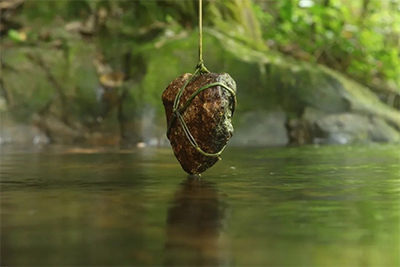
《作品2023-08-23-02》,叶文,影像静帧
Work 2023-08-23-02, Ye Wen, video still
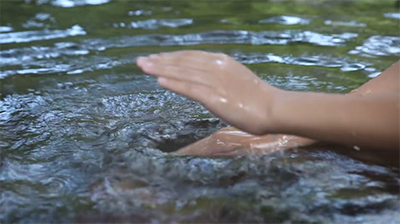
《在水中拍打节奏的孩童01》,叶文,影像静帧
The Child Rhythmically Beating the Water #1, Ye Wen, video still
我们小组的艺术家桂诗隽,她的创作也倾向于回到身体和知觉,并且完全信任身体。身体作为一个认知世界和沟通世界的基础,是主体同时也是客体。当她用身体这种感知的方法重新与世界建立联系时,她也重新发现自己。而李政德是一位观念摄影师,他引用了古人的语句去调侃,在山泉水里找了几颗石头,在岩壁上画出了他的“梧桐八景”,并拍摄下来作为静态作品。另外一位艺术家张利华,在他和我们一起外出的时候,经常通过静静坐在某一个地方进行观察,也会画一点小画或写一点文字。
Gui Shijun, an artist in our team, is also inclined to rely back on the body and perception and to fully trust the body in her practice. As a foundation for learning about and communicating with the world, the body is both the subject and the object. When she reconnected with the world with her body, or a tool of perception, she also found a new self of hers. Li Zhengde, another participant of the program, is a conceptual photographer, who employed quotes from ancient scholars in a playful way. He found a couple of rocks in a mountain spring, drew his version of one of the Eight Scenic Spots of Wutong Mountain on a cliff, and took photos of it as a static work. Zhang Lihua, another artist, would often sit quietly at a place for observation or to draw or write something simple when she was out with us.
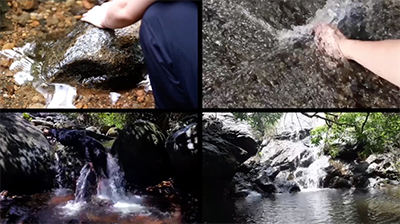
左上至右下:《洗石头》,《分水》,《瀑布》,《爬瀑布》,桂诗隽,行为影像静帧
From top left to bottom right: Washing the Stone, Dividing the Water, Waterfall, Climbing the Waterfal Gui Shijun, video stills of performances
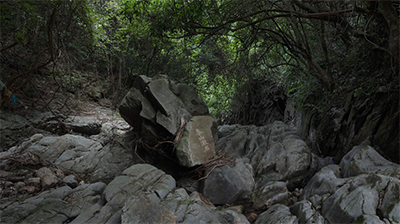
《泰山漱石》,李政德,摄影
Gargling Rocks by Tanshan Stream, Li Zhengde, photography
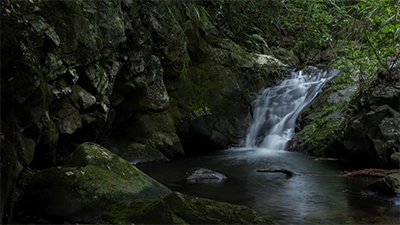
《桃花枕流》,李政德,摄影
Pillow Creek with Peach Blossoms, Li Zhengde, photography
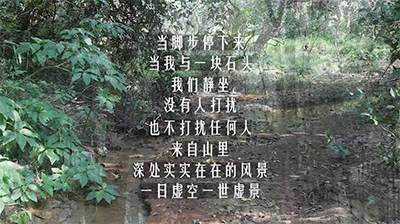
在梧桐山所作诗歌节选,张利华
An excerpt from a poem composed in Wutong Mountain, Zhang Lihua
黄珺瑶:我有几件作品也是在梧桐山实施的。其中一件《生命》,是因为当时心脏很不舒服,我希望感受水流在心脏位置的波动,于是在心脏的高度贴近水面射了一支空箭;而另外一件《词的现身》,是在山里实施的一分钟行为快照,我当时跪坐在水底,双手将所有衣物举过头顶,将大部分身体隐于水流。可以说,隐于一切可见与不可见之中,是我一直试图探讨的主题。在梧桐山行动的过程里,我们每次都会捡一根树枝或砍一小节树干作为登山杖,所以还有一件作品《下山》,我用到了这样的树枝,它一路跟随我划过仙湖—梧桐山的下山路径,直到城市人行道与斑马线,树枝就这样记录了从山到城市的地缘地貌的变化。
Huang Junyao: I also have a few pieces implemented in Wutong Mountain. One of them is Life, which originated from my hope to feel the undulation of flowing water at my chest as I didn’t feel good in my heart at that time, so I dry-fired the bow from the height of my heart when it was close to the surface of the water. Another one is The Appearance of Words, which is a one-minute series of action snapshots in the mountain. I was sitting on heels with most of my body hidden in the water and holding all of my clothes overhead with my hands. The piece embodies a theme I have been trying to explore: hiding in everything visible and invisible. During every Wutong Mountain action, we would find a wood stick or cut a section off a trunk as our hiking pole, which inspired my piece Going Down the Mountain. Such a stick of mine followed me along the route from Xianhu (Fairy Lake) down the Wutong Mountain all the way to an urban sidewalk and zebra crossing, so it documented the change in landform from the mountain to the city.
而发生在深圳湾日出剧场的《两棵树》是一个集体的行为创作,由李政德发起,我们小组中的四人都尝试了“滚草坪”这个动作,我分別从山坡的两边滚向两颗树,分享在两棵树之间飞来飞去的鸟群的快乐。
Two Trees is a collective performance piece staged in Sunrise Theater, Shenzhen Bay Park. Initiated by Li Zhengde, it features the activity of the four in our team “rolling on the lawn”, so I roll respectively from up two slopes to two trees to experience the fun of birds flying between trees.
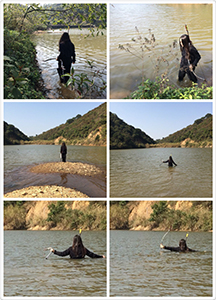
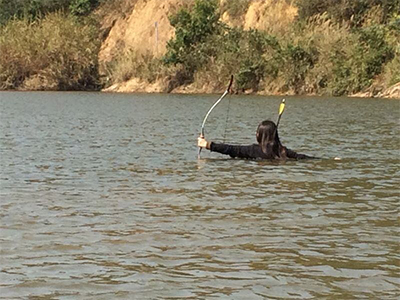
《生命》,黄珺瑶,行为现场摄影
Life, Huang Junyao, performance photographs
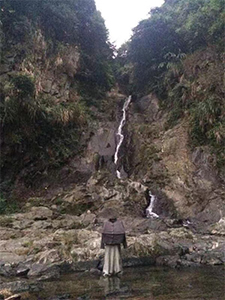
《词的现身》,黄珺瑶,行为现场摄影
he Appearance of Words, Huang Junyao, performance photograph
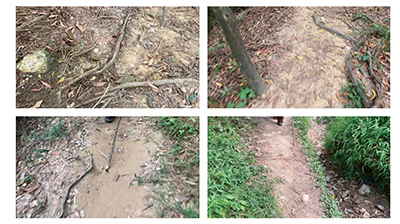
《下山》,黄珺瑶,行为影像静帧
Going Down the Mountain, Huang Junyao, video stills of performance
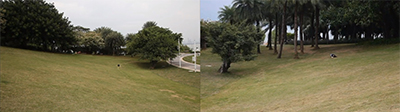
《两棵树》,黄珺瑶,行为影像静帧
Two Trees, Huang Junyao, video stills of performance
叶文:我们平时的工作会有一个原则,除了进一步的拍摄需要,基本是不带工具的。因为带工具就容易会有一个预设,比如说带什么工具,可以做什么。所以,我们基本上只是纯粹地带记录需要用到的摄像机、相机、手机。有时,我们也会跟偶遇的一些游客进行互动,让他们去做一些特别没有目的性、预测性的行为。
Ye Wen: We have a principle for our work in usual times: we don’t carry tools basically except for any further need for shooting. Because carrying tools will predestine us for something, like the kind of thing we can do with a certain type of tool. So, we basically only carry the camcorder, camera and phone necessary for recording. Sometimes, we would also interact with some tourists we met, like asking them to do something purposeless and unpredictable.
黄珺瑶:我认为,当自然最初指向的原型、精神性、神话性等等逐渐被 AI 图景占领取代时,人类集体意识迫切的需要回到原初,回到一个不受人类意志与虚拟图景支配的场域。到自然去,既是大自然作为人类古老能量中心的召唤,也是人作为自然元素参与者的行动网络的一部分。回到身体可以说是生命力的提纯,是身体作为自然管道的觉知中心,是用身体的动静态引动“物”与自然的最有效方式。
Huang Junyao: As I see it, while nature is losing its primary archetypes, spirituality, mythological nature, etc. to AI spectacles, it’s urgent that the collective consciousness of humanity return to the origin, or to an area out of the control of the human will and virtual spectacles. We go into nature not only to respond to the call of nature as the ancient energy center for mankind, but also because we are part of the action network of partakers of natural elements. Returning to the body is quite a way to refine vitality with the body as the perceptive core of the natural channel, and the most effective way to stimulate “things” and nature with the dynamic and static forms of the body.
叶文:只有当身份慢慢退却,身体才可能慢慢回归。
Ye Wen: Only when our identity gives way slowly can we gradually return to the body.
关于叶文
艺术创作者,自然艺术探索计划发起人。2007年毕业于中国艺术研究院,现居深圳。
作品涉及架上绘画、装置、影像、自然艺术等,主要探讨与记录时间、空间、及特定存在环境中作为生命个体的个体生命体验。作品曾参加《深港建筑双城双年展》深圳南头古城;第二、第四、第五届《深圳当代艺术双年展》深圳;《2019当代艺术邀请展》深圳美术馆;《第六届深圳公共雕塑展》深圳公共艺术中心;第一、三、五、七、九届《深圳青年艺术周》等展览。并于2017年在深圳美术馆、2018年在香港中文大学(香港)、2020年在森空间举办个人作品展及讲座活动。出版有《时间档案——叶文作品集》等。。
关于黄珺瑶
祖籍湖南,黄珺瑶现工作生活于深圳。艺术创作涉及架上绘画、行为、装置等。作品常关注身体与自然、神秘学与智性之间的转换,在日常修行中观察与感知世界。作品曾参加深圳当代艺术文献展,威尼斯双年展元宇宙展等。神秘学研究与实践者。主攻西方现代占星、古典占星等。英国伦敦占星学院学员(LSA)。华人占星协会认证古典占星师。美国ICRT认证灵气疗愈师。 天使疗愈、风水研究爱好者。
About Ye Wen
Ye Wen, Artist and Initiator of Nature Art Exploration Program. Graduated in 2007 from Chinese National Academy of Arts, Ye Wen currently resides in Shenzhen. His artistic repertoire encompasses painting, installation, video, and natural art. His work primarily delves into and documents the individual life experiences within the contexts of time, space, and specific environments. His creations have been featured in various prestigious exhibitions, including: The Shenzhen-Hong Kong Bi-City Biennale of Urbanism\Architecture at Shenzhen Nantou Ancient City, The 2nd, 4th, and 5th Shenzhen Biennale of Contemporary Art, The 2019 Contemporary Art Invitational Exhibition at Shenzhen Art Museum, The 6th Shenzhen Public Sculpture Exhibition at Shenzhen Public Art Center, The 1st, 3rd, 5th, 7th, and 9th Shenzhen Youth Art Week, among others. Ye Wen also hosted solo exhibitions and lectures at Shenzhen Art Museum in 2017, The Chinese University of Hong Kong in 2018, and Sen Space in 2020. His published books include "Time Archives: Ye Wen Works Collection" and others.
About Huang Junyao
Originally from Hunan, HUANG Junyao is currently based in Shenzhen. Her artistic creations span easel painting, performance, and installation art. Her works often explore the interplay between the body and nature, as well as the transition between mysticism and intellect, observing and perceiving the world through daily practices. HUANG's works have been featured in the Shenzhen Contemporary Art Documentation Exhibition, the Venice Biennale's Metaverse Exhibition, the Shenzhen Biennale of Contemporary Art, Shenzhen Artists Week, among others.
An avid researcher and practitioner in the field of mysticism, Huang specializes in Western modern astrology, classical astrology, and is a student at the London School of Astrology (LSA). She is a certified classical astrologer with the Chinese Astrology Association, a certified Reiki Master with the US ICRT (Usui Reiki), and a Shamballa Reiki Master with Australia's CASA. Additionally, she is an enthusiast in angel healing and Feng Shui studies.